Dragon STEM · Read it in the book
Play the gameYour game is still open. Switch to its tab.

Copies are not more proof
Seeing the same message many times does not make it true. 5 relays sent the same alert, but it all came from 1 source. Count the sources, not the copies.
Word: Copy: the same message repeated, not new proof.
Read the words
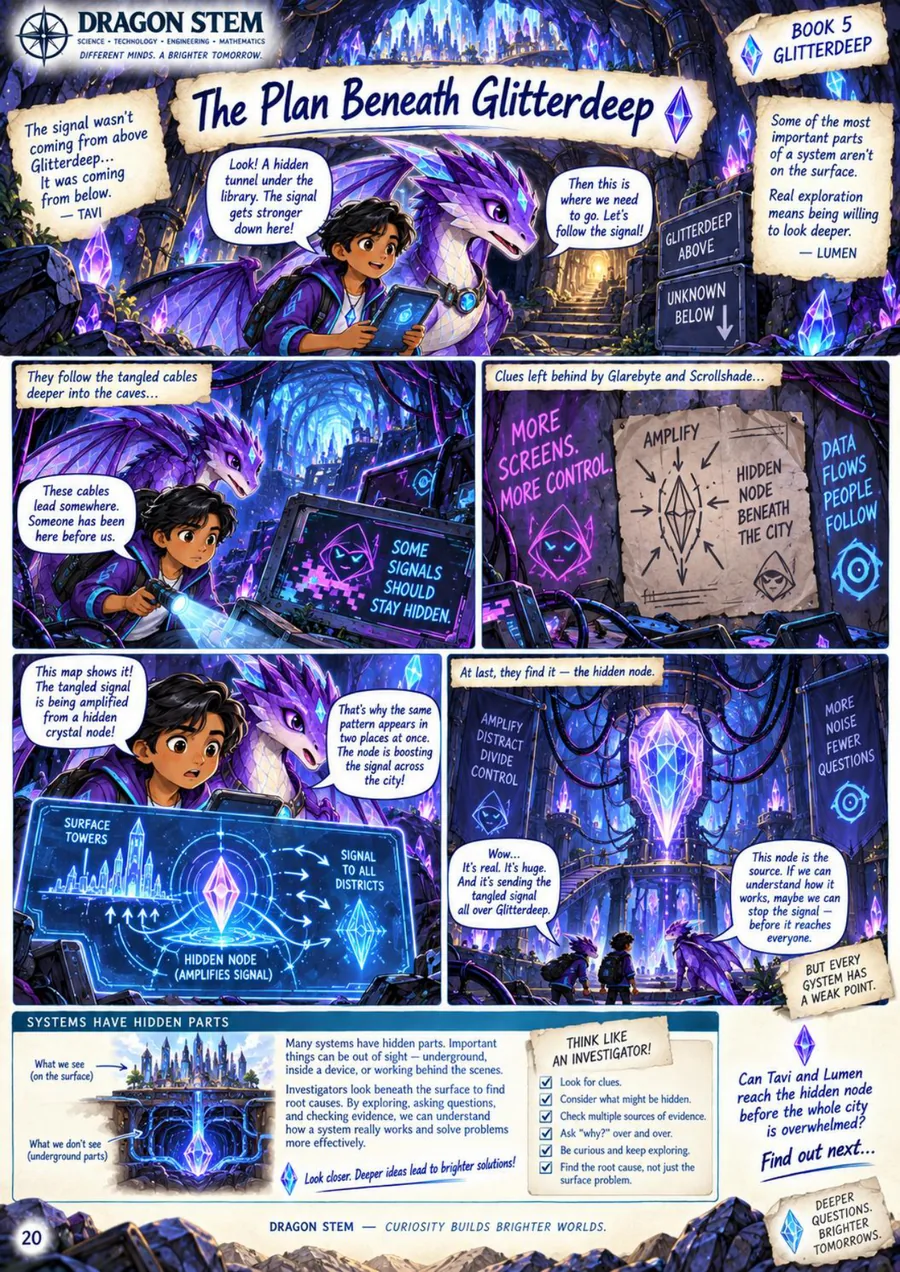
Tavi: "The signal wasn't coming from above Glitterdeep... It was coming from below."
"Look! A hidden tunnel under the library. The signal gets stronger down here!"
"Then this is where we need to go. Let's follow the signal!"
Lumen: "Some of the most important parts of a system aren't on the surface. Real exploration means being willing to look deeper."
They follow the tangled cables deeper into the caves... "These cables lead somewhere. Someone has been here before us." "Some signals should stay hidden."
Clues left behind by Glarebyte and Scrollshade... "More screens. More control." "Amplify. Hidden node beneath the city." "Data flows. People follow."
"This map shows it! The tangled signal is being amplified from a hidden crystal node!" "That's why the same pattern appears in two places at once. The node is boosting the signal across the city!"
Surface Towers. Hidden Node (Amplifies Signal). Signal to All Districts.
At last, they find it — the hidden node. "Amplify. Distract. Divide. Control." "More noise. Fewer questions."
"Wow... It's real. It's huge. And it's sending the tangled signal all over Glitterdeep."
"This node is the source. If we can understand how it works, maybe we can stop the signal — before it reaches everyone." But every system has a weak point.
Systems Have Hidden Parts: What we see (on the surface). What we don't see (underground parts). Many systems have hidden parts. Important things can be out of sight — underground, inside a device, or working behind the scenes.
Investigators look beneath the surface to find root causes. By exploring, asking questions, and checking evidence, we can understand how a system really works and solve problems more effectively.
Think Like an Investigator! Look for clues. Consider what might be hidden. Check multiple sources of evidence. Ask "why?" over and over. Be curious and keep exploring. Find the root cause, not just the surface problem.
Look closer. Deeper ideas lead to brighter solutions.
Can Tavi and Lumen reach the hidden node before the whole city is overwhelmed? Find out next...
Read the words
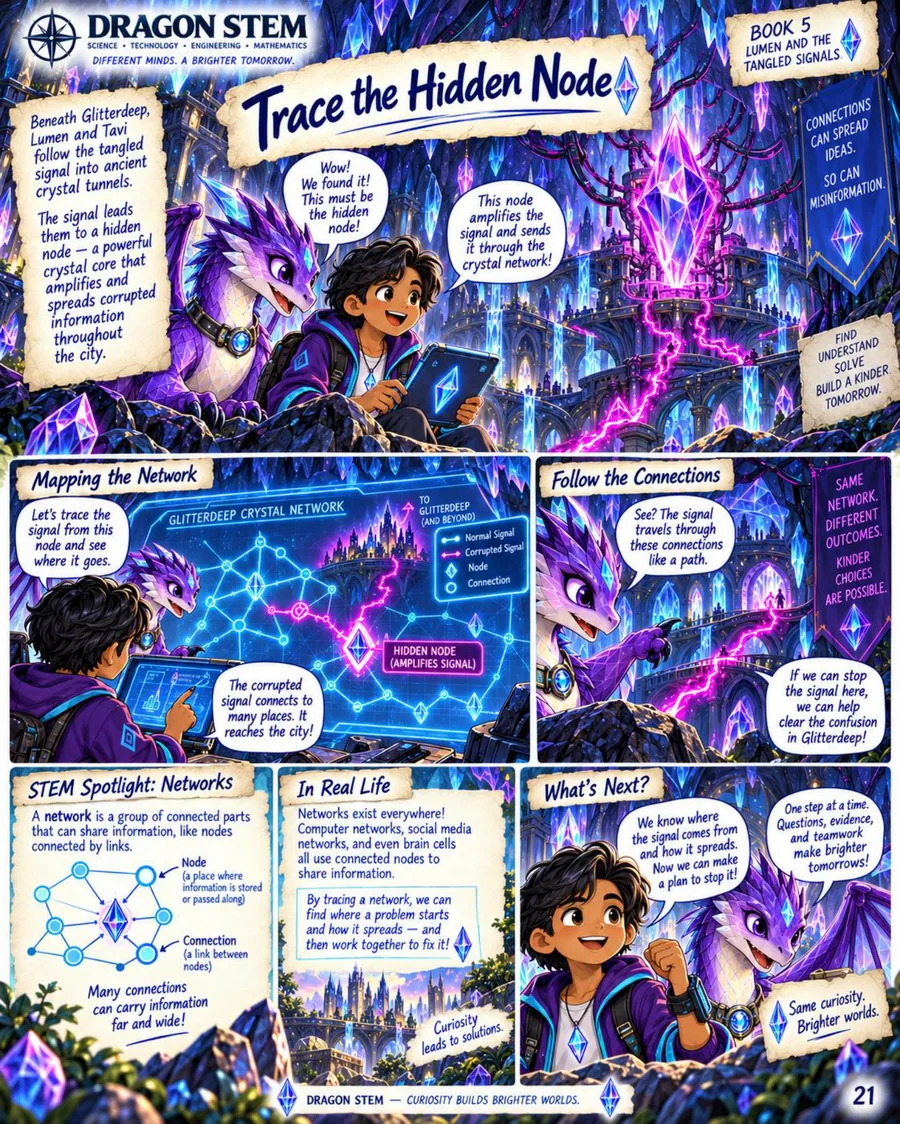
Beneath Glitterdeep, Lumen and Tavi follow the tangled signal into ancient crystal tunnels.
The signal leads them to a hidden node — a powerful crystal core that amplifies and spreads corrupted information throughout the city.
"Wow! We found it! This must be the hidden node!" "This node amplifies the signal and sends it through the crystal network!"
Connections can spread ideas. So can misinformation.
Mapping the Network: "Let's trace the signal from this node and see where it goes." "The corrupted signal connects to many places. It reaches the city!"
Glitterdeep Crystal Network: Normal Signal. Corrupted Signal. Node. Connection. Hidden Node (Amplifies Signal). To Glitterdeep (and beyond).
Follow the Connections: "See? The signal travels through these connections like a path." "If we can stop the signal here, we can help clear the confusion in Glitterdeep!"
Same network. Different outcomes. Kinder choices are possible.
STEM Spotlight: Networks — A network is a group of connected parts that can share information, like nodes connected by links. Node (a place where information is stored or passed along). Connection (a link between nodes). Many connections can carry information far and wide!
In Real Life: Networks exist everywhere! Computer networks, social media networks, and even brain cells all use connected nodes to share information. By tracing a network, we can find where a problem starts and how it spreads — and then work together to fix it! Curiosity leads to solutions.
What's Next? "We know where the signal comes from and how it spreads. Now we can make a plan to stop it!" "One step at a time. Questions, evidence, and teamwork make brighter tomorrows!"
Same curiosity. Brighter worlds.
Read the words
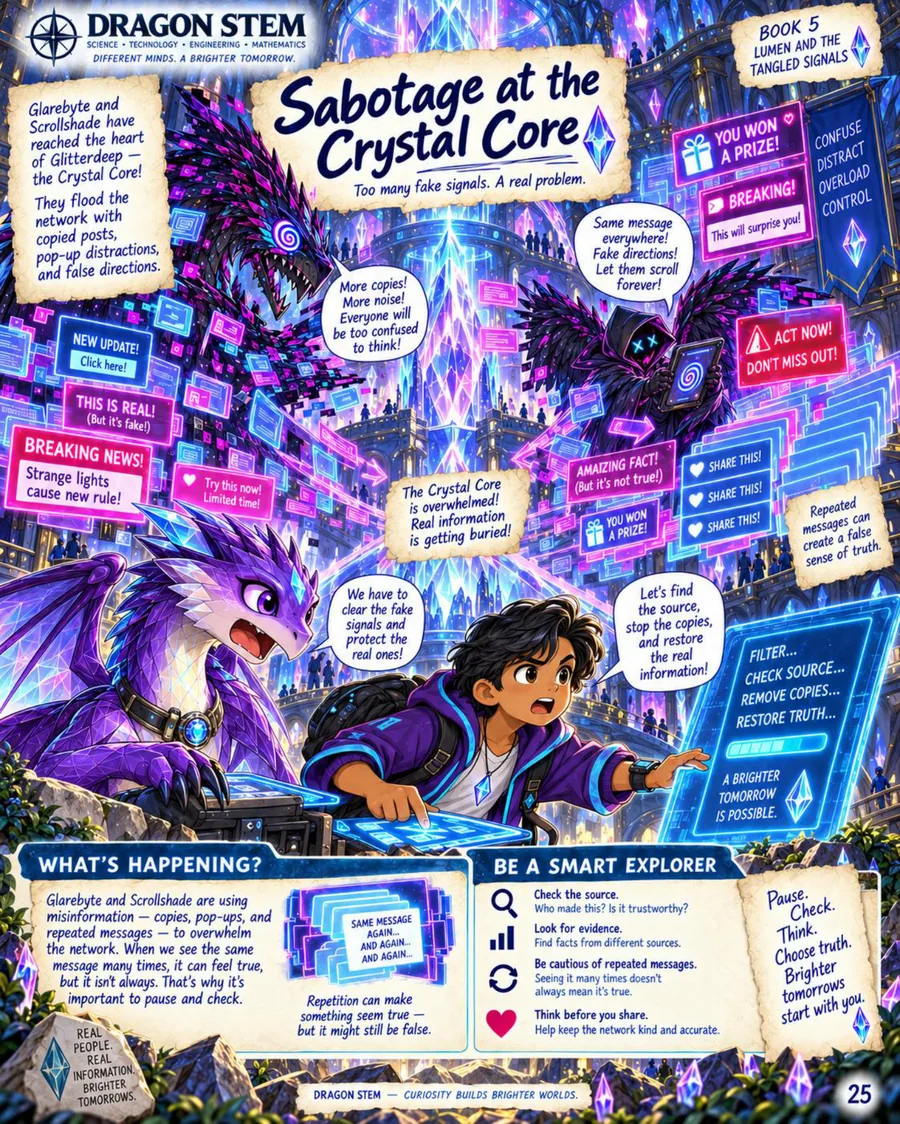
Too many fake signals. A real problem.
Glarebyte and Scrollshade have reached the heart of Glitterdeep — the Crystal Core! They flood the network with copied posts, pop-up distractions, and false directions.
"More copies! More noise! Everyone will be too confused to think!"
"Same message everywhere! Fake directions! Let them scroll forever!"
"The Crystal Core is overwhelmed! Real information is getting buried!"
"We have to clear the fake signals and protect the real ones!" "Let's find the source, stop the copies, and restore the real information!"
Repeated messages can create a false sense of truth.
Filter... Check source... Remove copies... Restore truth... A brighter tomorrow is possible.
What's Happening? Glarebyte and Scrollshade are using misinformation — copies, pop-ups, and repeated messages — to overwhelm the network. When we see the same message many times, it can feel true, but it isn't always. That's why it's important to pause and check.
Repetition can make something seem true — but it might still be false.
Be a Smart Explorer: Check the source. Who made this? Is it trustworthy? Look for evidence. Find facts from different sources. Be cautious of repeated messages. Seeing it many times doesn't always mean it's true. Think before you share. Help keep the network kind and accurate.
Pause. Check. Think. Choose truth. Brighter tomorrows start with you.
Read the words
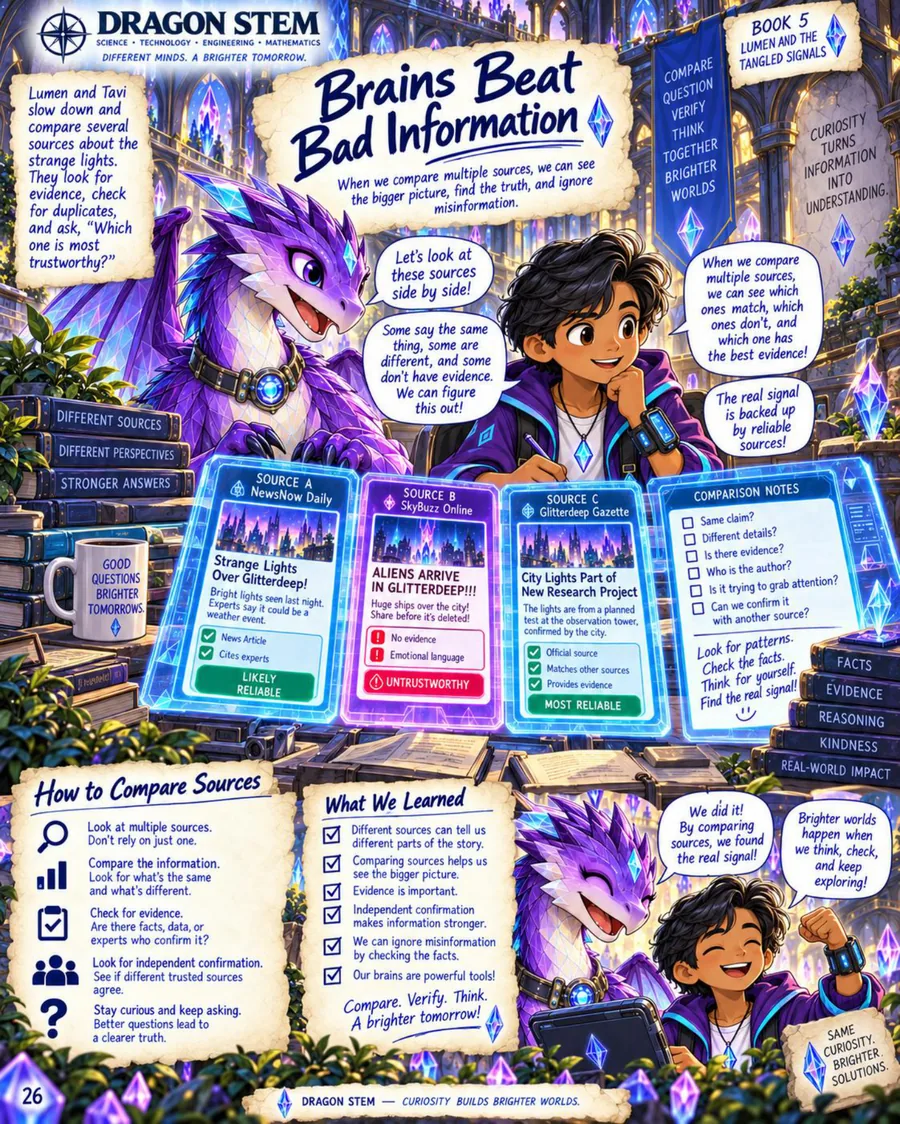
When we compare multiple sources, we can see the bigger picture, find the truth, and ignore misinformation.
Lumen and Tavi slow down and compare several sources about the strange lights. They look for evidence, check for duplicates, and ask, "Which one is most trustworthy?"
"Let's look at these sources side by side!" "Some say the same thing, some are different, and some don't have evidence. We can figure this out!"
"When we compare multiple sources, we can see which ones match, which ones don't, and which one has the best evidence!" "The real signal is backed up by reliable sources!"
Source A, NewsNow Daily: "Strange Lights Over Glitterdeep!" Bright lights seen last night. Experts say it could be a weather event. News Article. Cites experts. Likely Reliable.
Source B, SkyBuzz Online: "ALIENS ARRIVE IN GLITTERDEEP!!!" Huge ships over the city! Share before it's deleted! No evidence. Emotional language. Untrustworthy.
Source C, Glitterdeep Gazette: "City Lights Part of New Research Project" The lights are from a planned test at the observation tower, confirmed by the city. Official source. Matches other sources. Provides evidence. Most Reliable.
Comparison Notes: Same claim? Different details? Is there evidence? Who is the author? Is it trying to grab attention? Can we confirm it with another source? Look for patterns. Check the facts. Think for yourself. Find the real signal!
How to Compare Sources: Look at multiple sources. Don't rely on just one. Compare the information. Look for what's the same and what's different. Check for evidence. Are there facts, data, or experts who confirm it? Look for independent confirmation. See if different trusted sources agree. Stay curious and keep asking. Better questions lead to a clearer truth.
What We Learned: Different sources can tell us different parts of the story. Comparing sources helps us see the bigger picture. Evidence is important. Independent confirmation makes information stronger. We can ignore misinformation by checking the facts. Our brains are powerful tools!
Compare. Verify. Think. A brighter tomorrow!
"We did it! By comparing sources, we found the real signal!" "Brighter worlds happen when we think, check, and keep exploring!"
Read the words
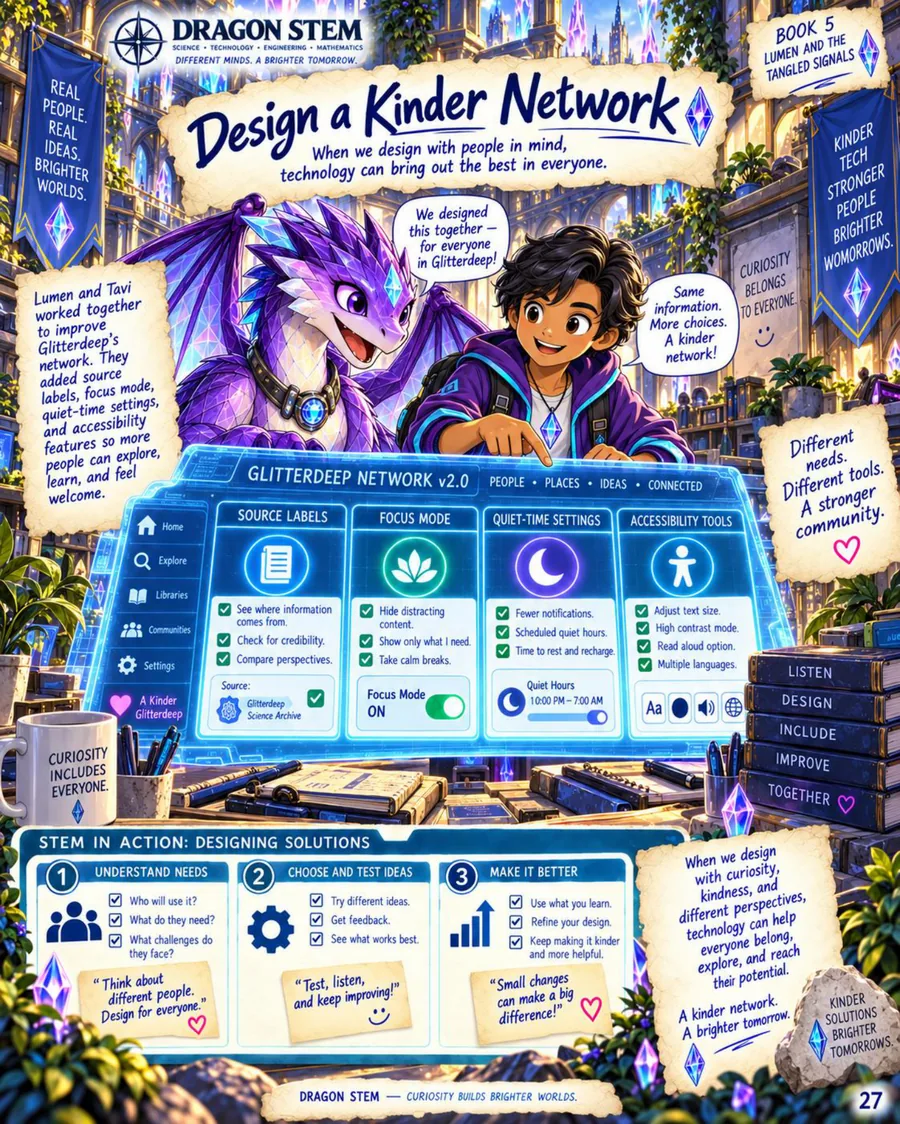
When we design with people in mind, technology can bring out the best in everyone.
Lumen and Tavi worked together to improve Glitterdeep's network. They added source labels, focus mode, quiet-time settings, and accessibility features so more people can explore, learn, and feel welcome.
"We designed this together — for everyone in Glitterdeep!" "Same information. More choices. A kinder network!"
Glitterdeep Network v2.0: People. Places. Ideas. Connected. Home. Explore. Libraries. Communities. Settings. A Kinder Glitterdeep.
Source Labels: See where information comes from. Check for credibility. Compare perspectives. Source: Glitterdeep Science Archive.
Focus Mode: Hide distracting content. Show only what I need. Take calm breaks. Focus Mode ON.
Quiet-Time Settings: Fewer notifications. Scheduled quiet hours. Time to rest and recharge. Quiet Hours 10:00 PM – 7:00 AM.
Accessibility Tools: Adjust text size. High contrast mode. Read aloud option. Multiple languages.
STEM in Action: Designing Solutions — 1 Understand Needs: Who will use it? What do they need? What challenges do they face? "Think about different people. Design for everyone."
2 Choose and Test Ideas: Try different ideas. Get feedback. See what works best. "Test, listen, and keep improving!"
3 Make It Better: Use what you learn. Refine your design. Keep making it kinder and more helpful. "Small changes can make a big difference!"
When we design with curiosity, kindness, and different perspectives, technology can help everyone belong, explore, and reach their potential.
A kinder network. A brighter tomorrow.
Read the words
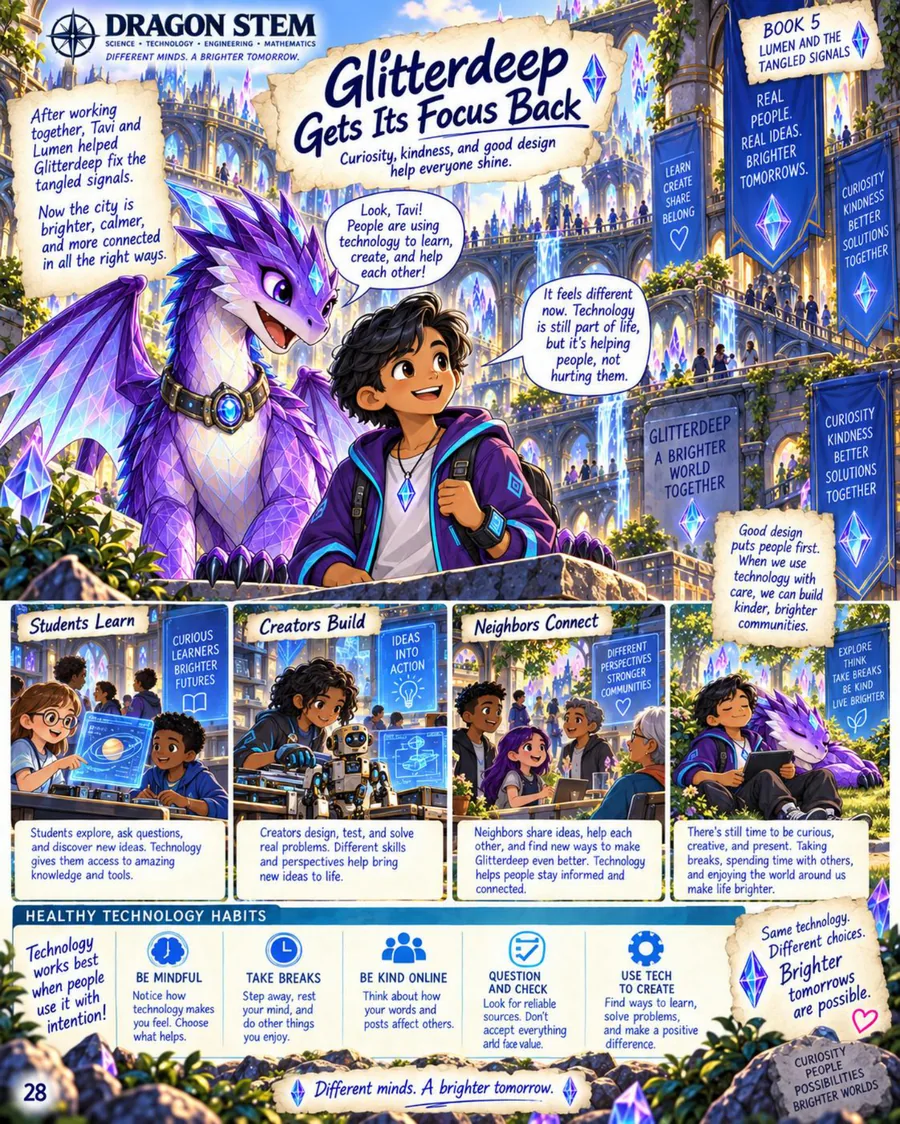
Curiosity, kindness, and good design help everyone shine.
After working together, Tavi and Lumen helped Glitterdeep fix the tangled signals. Now the city is brighter, calmer, and more connected in all the right ways.
"Look, Tavi! People are using technology to learn, create, and help each other!" "It feels different now. Technology is still part of life, but it's helping people, not hurting them."
Students Learn: Students explore, ask questions, and discover new ideas. Technology gives them access to amazing knowledge and tools.
Creators Build: Creators design, test, and solve real problems. Different skills and perspectives help bring new ideas to life.
Neighbors Connect: Neighbors share ideas, help each other, and find new ways to make Glitterdeep even better. Technology helps people stay informed and connected.
There's still time to be curious, creative, and present. Taking breaks, spending time with others, and enjoying the world around us make life brighter.
Technology works best when people use it with intention!
Healthy Technology Habits: Be Mindful: Notice how technology makes you feel. Choose what helps. Take Breaks: Step away, rest your mind, and do other things you enjoy. Be Kind Online: Think about how your words and posts affect others. Question and Check: Look for reliable sources. Don't accept everything arld face value. Use Tech to Create: Find ways to learn, solve problems, and make a positive difference.
Good design puts people first. When we use technology with care, we can build kinder, brighter communities.
Same technology. Different choices. Brighter tomorrows are possible.
- Find a message that was shared many times with a grown-up.
- Try to trace it back to where it first started.
- Count how many different original sources you find.
You need: a shared message or post, a grown-up's help.
Ask a grown-up first.
Can you remember? You see the same rumor posted by 10 different accounts. How many real sources might that be?
Maybe just 1. Copies can spread from a single source.
For grown-ups
Learning goal: I can trace copies back to their source, explain why copies are not extra evidence, and test again after a fix.
Grade 4-5.
| Code | Standard |
|---|---|
| CSTA 1B-NI-04 | Model how information is broken down into smaller pieces, transmitted as packets through multiple devices over networks and the Internet, and reassembled at the destination. |
| CSTA 1B-DA-07 | Use data to highlight or propose cause-and-effect relationships, predict outcomes, or communicate an idea. |
| ISTE-S 3b | Students evaluate the accuracy, perspective, credibility and relevance of information, media, data or other resources. |
| CSTA 1B-AP-15 | Test and debug (identify and fix errors) a program or algorithm to ensure it runs as intended. |
Talk about it:
- Why are 5 copies of the same claim not 5 pieces of proof?
- What would you check first after fixing a root cause?
About 9 minutes.
How the game teaches it: evidence first, then the rider's hints (never the answer); no stars, scores or timers.
The full teacher guide is in the book.
Only the pages from this mission are shown here. From the Dragon STEM series by Adisak Sukul.