Dragon STEM · Read it in the book
Play the gameYour game is still open. Switch to its tab.

Find the source
A problem often starts at one source. Litter was jammed at the tide gate, not made there. Clearing the real source helps the whole area.
Word: Source: the place something comes from.
Read the words
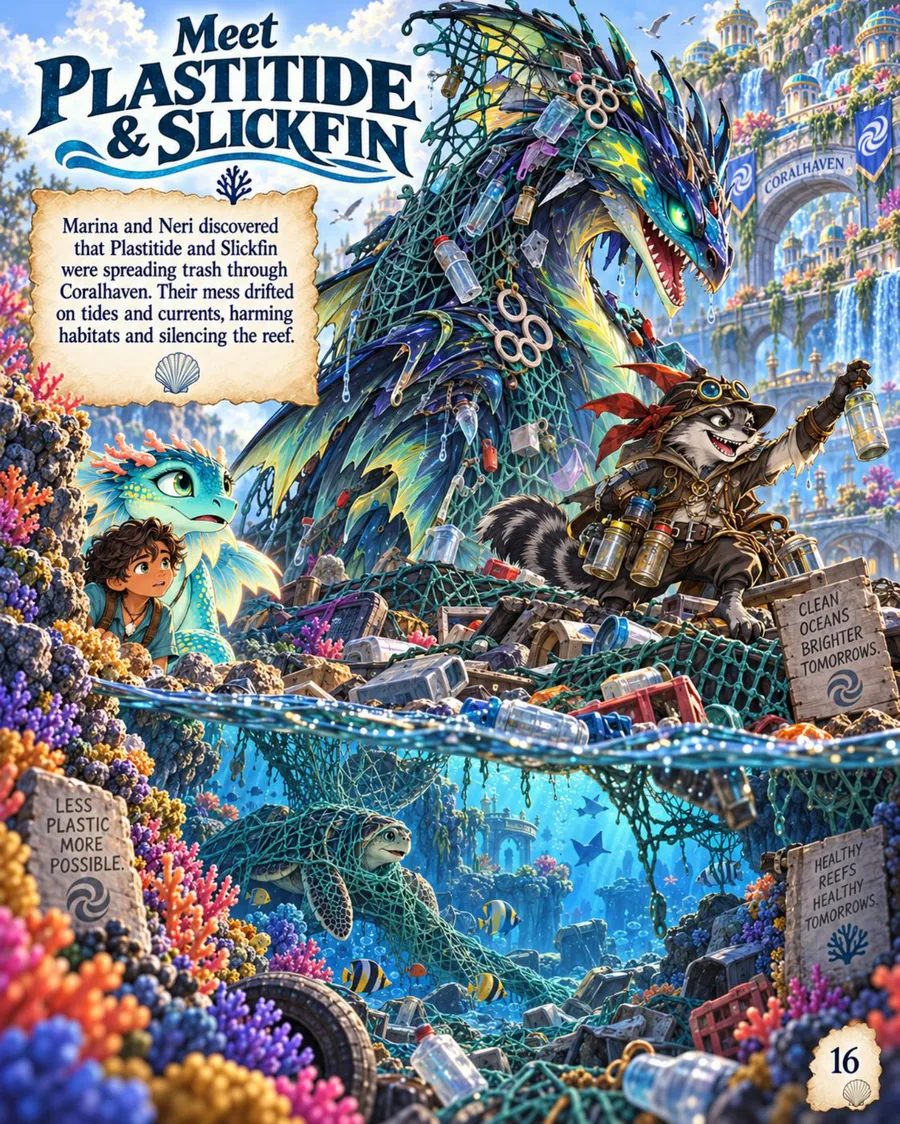
Marina and Neri discovered that Plastitide and Slickfin were spreading trash through Coralhaven.
Their mess drifted on tides and currents, harming habitats and silencing the reef.
Read the words
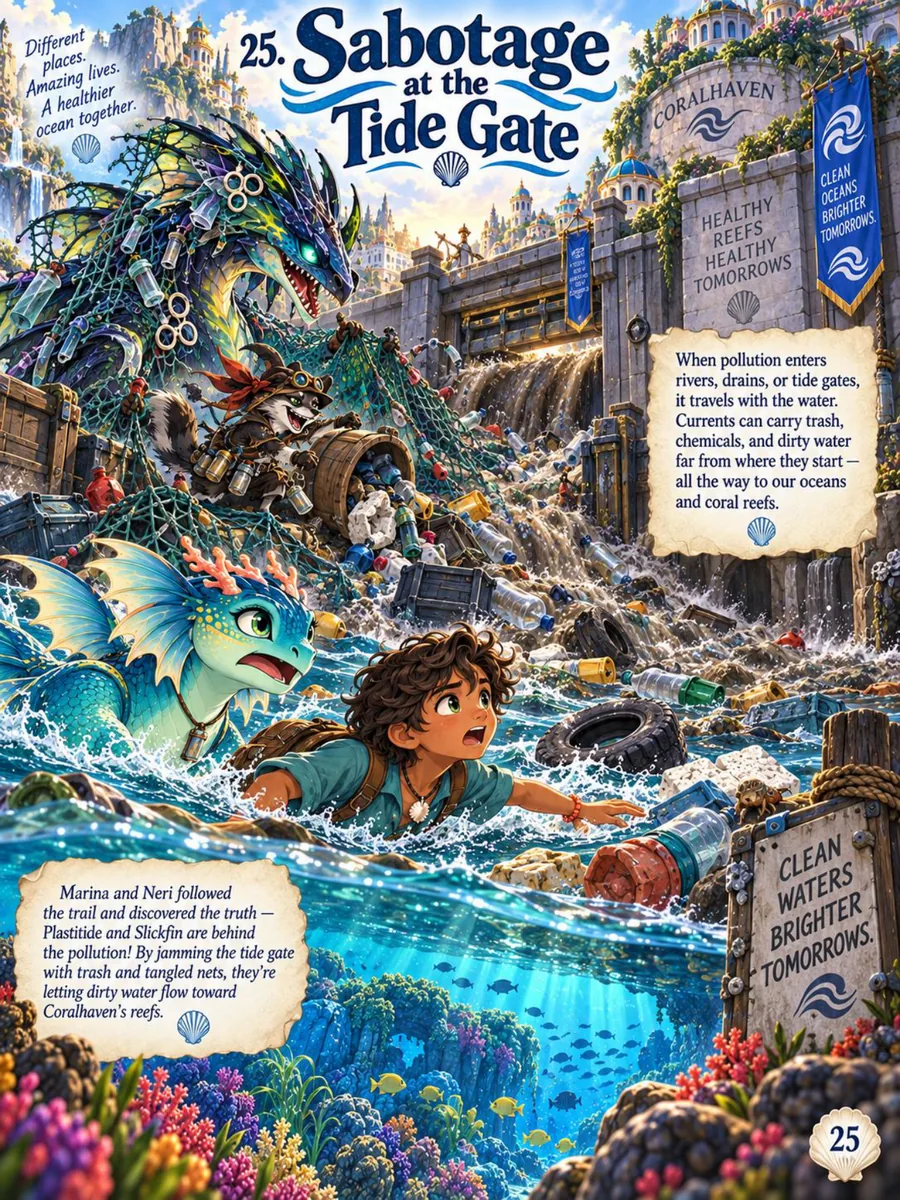
Marina and Neri followed the trail and discovered the truth — Plastitide and Slickfin are behind the pollution!
By jamming the tide gate with trash and tangled nets, they're letting dirty water flow toward Coralhaven's reefs.
When pollution enters rivers, drains, or tide gates, it travels with the water.
Currents can carry trash, chemicals, and dirty water far from where they start — all the way to our oceans and coral reefs.
Read the words
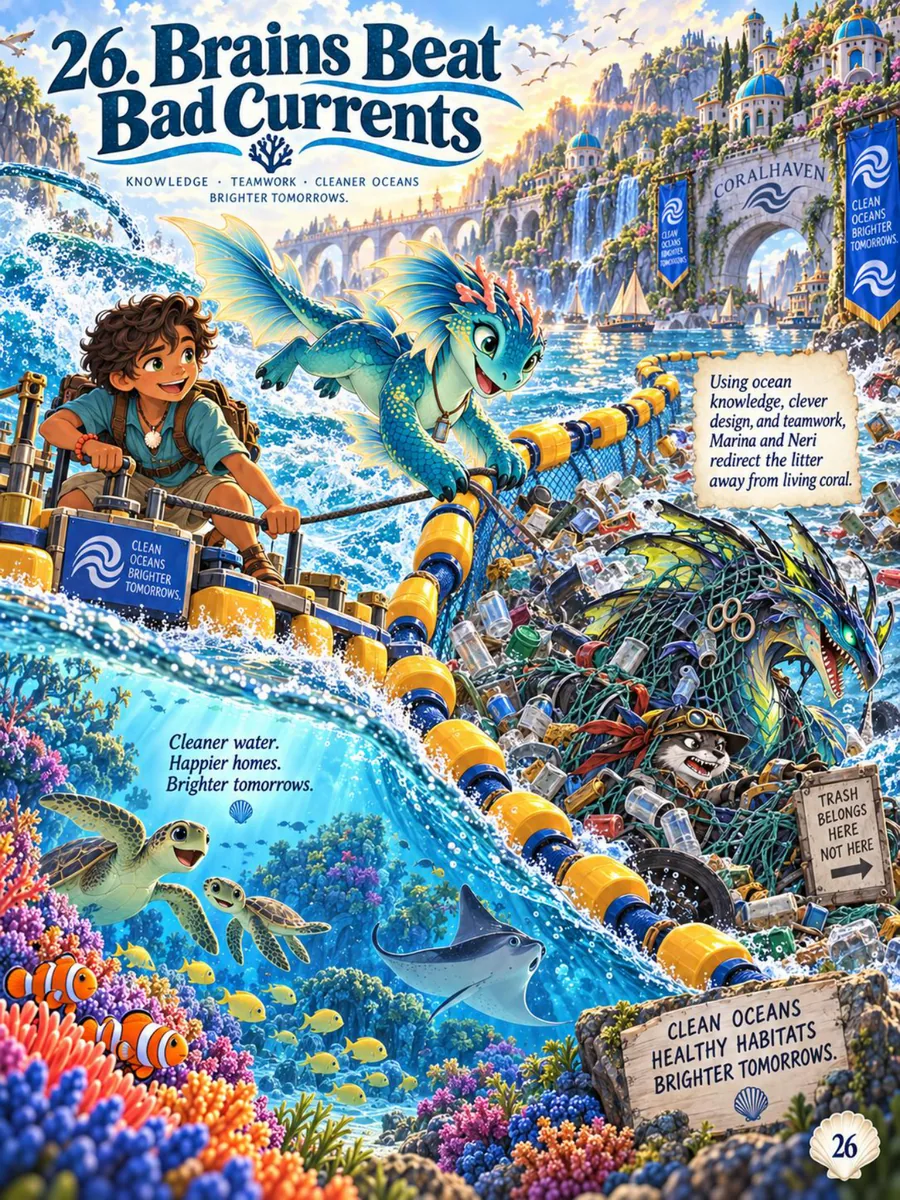
Knowledge · Teamwork · Cleaner oceans. Brighter tomorrows.
Using ocean knowledge, clever design, and teamwork, Marina and Neri redirect the litter away from living coral.
Sign: "Trash belongs here, not here" (with an arrow)
Cleaner water. Happier homes. Brighter tomorrows.
Read the words
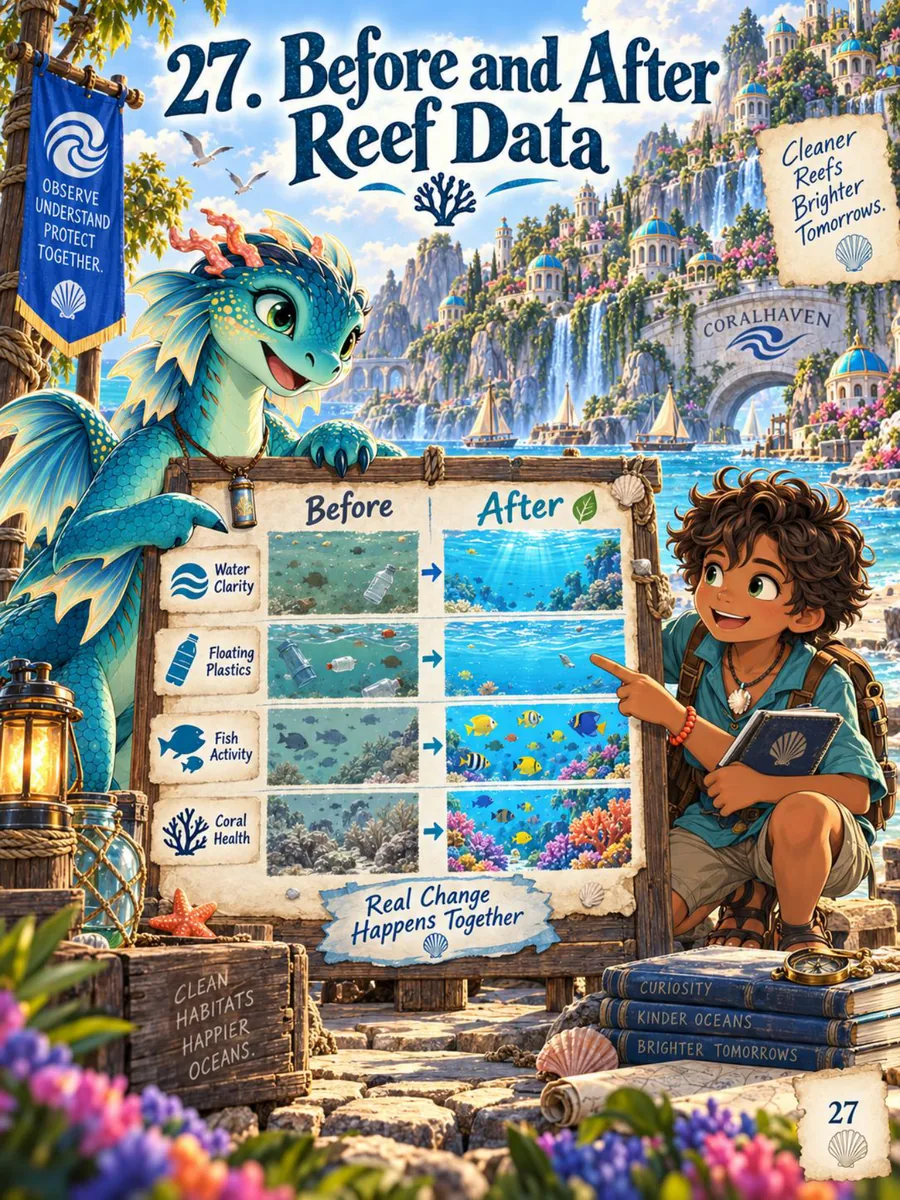
Before and after comparison: Water Clarity, Floating Plastics, Fish Activity, and Coral Health each improved from before to after.
Real change happens together.
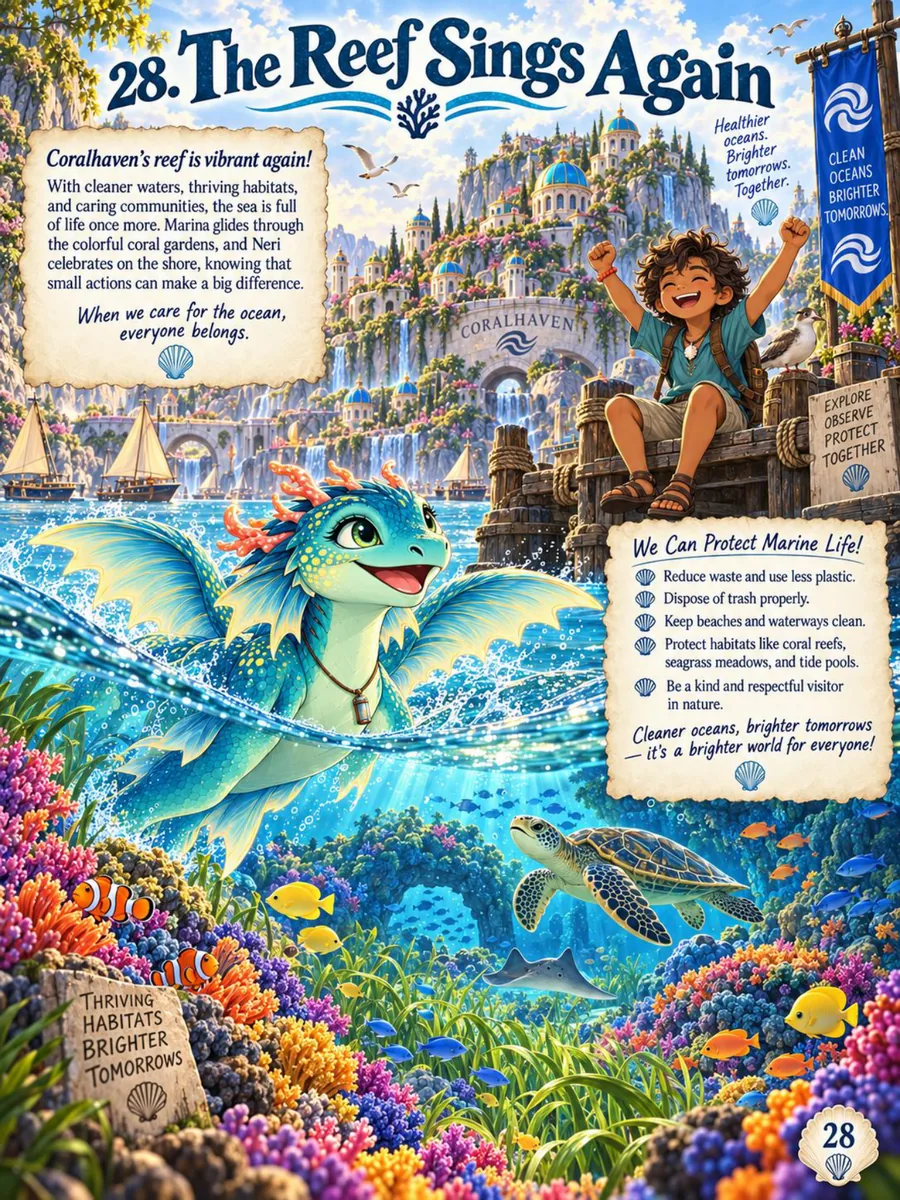
Read the words
Coralhaven's reef is vibrant again!
With cleaner waters, thriving habitats, and caring communities, the sea is full of life once more.
Marina glides through the colorful coral gardens, and Neri celebrates on the shore, knowing that small actions can make a big difference.
When we care for the ocean, everyone belongs.
We Can Protect Marine Life! Reduce waste and use less plastic. Dispose of trash properly. Keep beaches and waterways clean. Protect habitats like coral reefs, seagrass meadows, and tide pools. Be a kind and respectful visitor in nature.
Cleaner oceans, brighter tomorrows — it's a brighter world for everyone!
- Find a trail of something at home, like crumbs or water drops.
- Follow the trail to where it starts.
- That starting point is the source.
You need: none, just your eyes.
Can you remember? Bubbles keep floating up in one spot of a pond. Where should you look first?
Right under that spot, for whatever is making the bubbles.
For grown-ups
Learning goal: I can clear a pollution source, explain why pushing trash out to sea is not a solution, and use before and after data to judge a cleanup.
Grade 3-5.
| Code | Standard |
|---|---|
| 5-ESS3-1 | Obtain and combine information about ways individual communities use science ideas to protect the Earth's resources and environment. |
| 3-LS4-4 | Make a claim about the merit of a solution to a problem caused when the environment changes and the types of plants and animals that live there may change. |
| 3.MD.B.3 | Draw a scaled picture graph and a scaled bar graph to represent a data set with several categories. Solve one- and two-step "how many more" and "how many less" problems using information presented in scaled bar graphs. |
Talk about it:
- Why doesn't moving a problem somewhere else actually solve it?
- What is one source of litter or runoff you could help reduce nearby?
About 10 minutes.
How the game teaches it: evidence first, then the rider's hints (never the answer); no stars, scores or timers.
The full teacher guide is in the book.
Only the pages from this mission are shown here. From the Dragon STEM series by Adisak Sukul.