Dragon STEM · Read it in the book
Play the gameYour game is still open. Switch to its tab.

Goals and limits
Criteria are what a design must do. Constraints are the limits we must follow. A filter's criterion is to catch ash. A constraint is using only what we have.
Word: Criteria: what a design must do to succeed.
Read the words
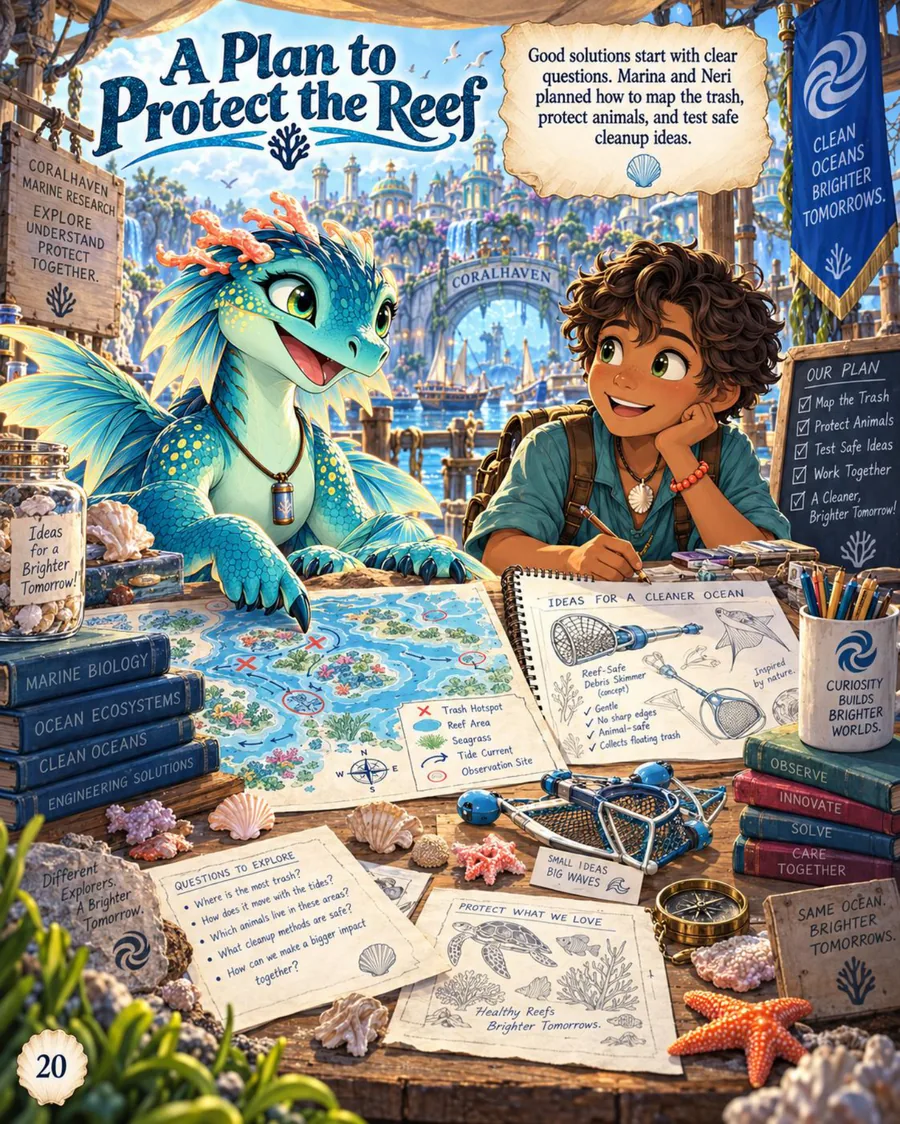
Good solutions start with clear questions.
Marina and Neri planned how to map the trash, protect animals, and test safe cleanup ideas.
Our Plan: Map the Trash. Protect Animals. Test Safe Ideas. Work Together. A Cleaner, Brighter Tomorrow!
Map key: Trash Hotspot. Reef Area. Seagrass. Tide Current. Observation Site.
Ideas for a Cleaner Ocean — Reef-Safe Debris Skimmer (concept): Gentle. No sharp edges. Animal-safe. Collects floating trash. Inspired by nature.
Questions to Explore: Where is the most trash? How does it move with the tides? Which animals live in these areas? What cleanup methods are safe? How can we make a bigger impact together?
Read the words
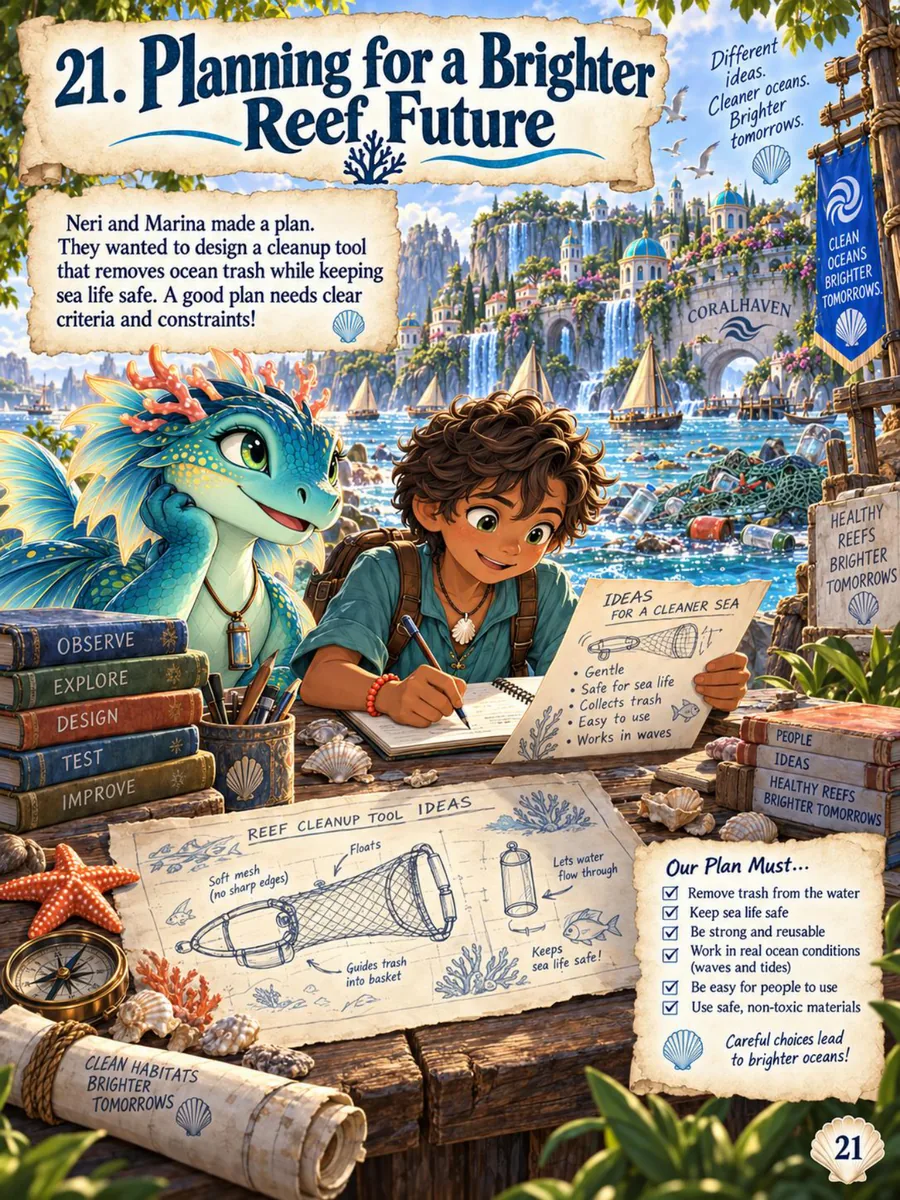
Neri and Marina made a plan.
They wanted to design a cleanup tool that removes ocean trash while keeping sea life safe.
A good plan needs clear criteria and constraints!
Ideas for a Cleaner Sea: Gentle. Safe for sea life. Collects trash. Easy to use. Works in waves.
Reef Cleanup Tool Ideas: Soft mesh (no sharp edges). Floats. Guides trash into basket. Keeps sea life safe! Lets water flow through.
Our Plan Must...: Remove trash from the water. Keep sea life safe. Be strong and reusable. Work in real ocean conditions (waves and tides). Be easy for people to use. Use safe, non-toxic materials.
Careful choices lead to brighter oceans!
Read the words
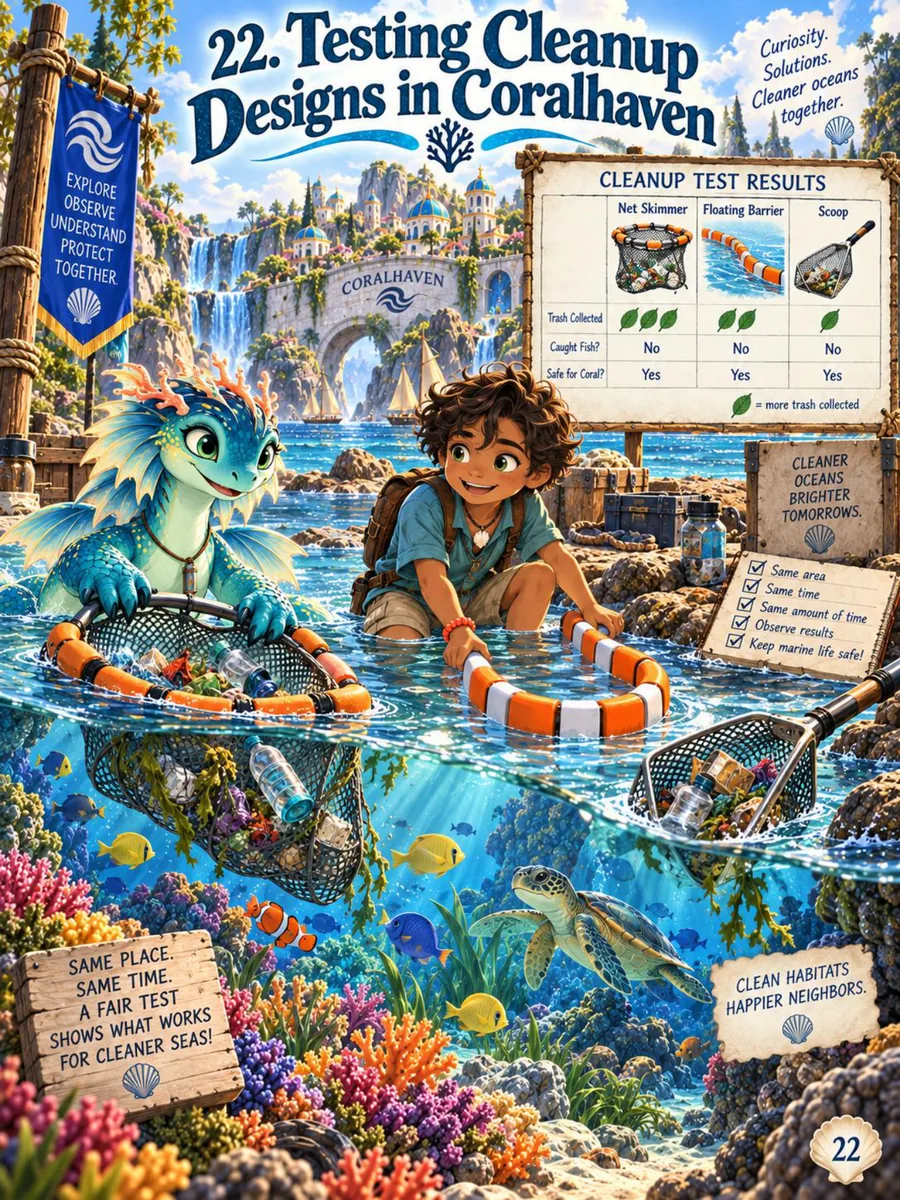
Cleanup Test Results — Net Skimmer: Trash Collected (most), Caught Fish? No, Safe for Coral? Yes.
Floating Barrier: Trash Collected (moderate), Caught Fish? No, Safe for Coral? Yes.
Scoop: Trash Collected (least), Caught Fish? No, Safe for Coral? Yes.
Same area. Same time. Same amount of time. Observe results. Keep marine life safe!
Same place. Same time. A fair test shows what works for cleaner seas!
Read the words
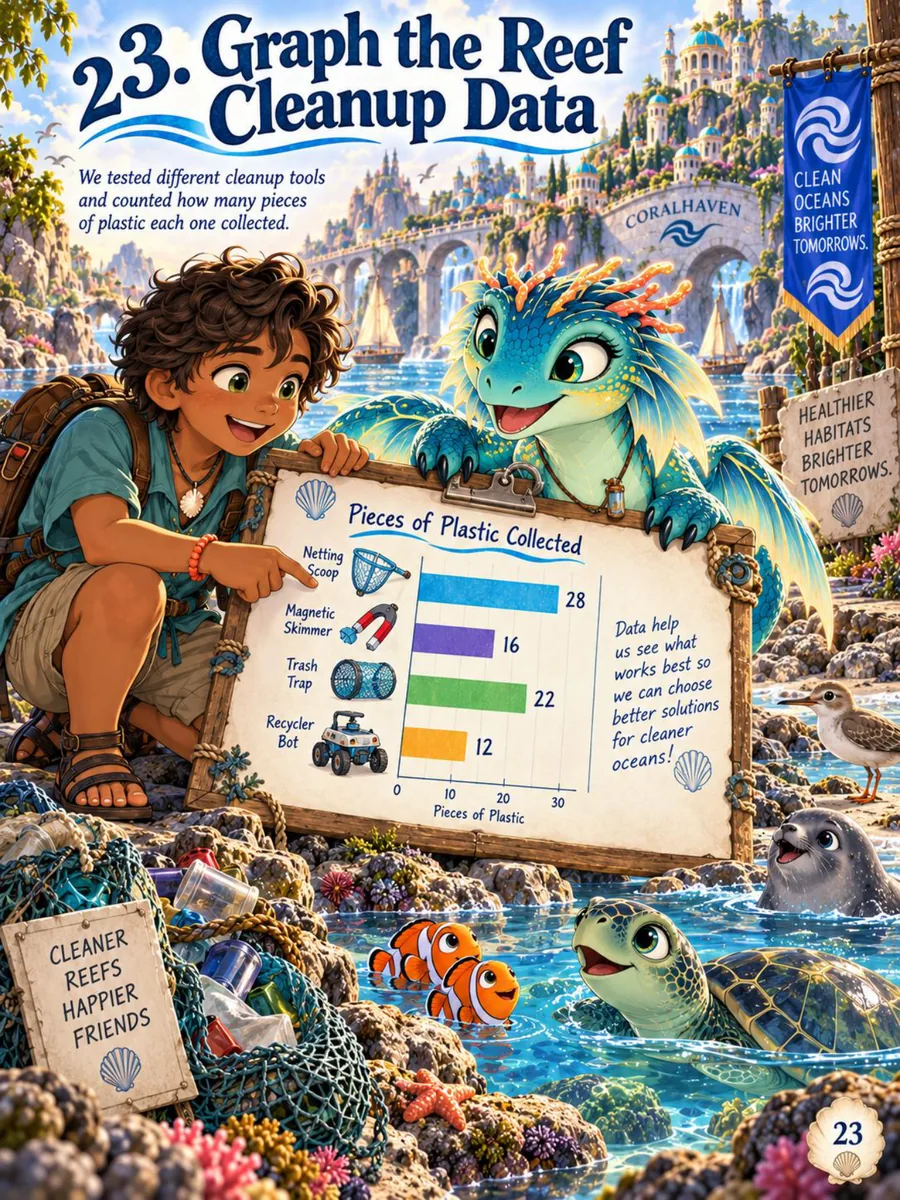
We tested different cleanup tools and counted how many pieces of plastic each one collected.
Pieces of Plastic Collected — Netting Scoop: 28. Magnetic Skimmer: 16. Trash Trap: 22. Recycler Bot: 12.
Data help us see what works best so we can choose better solutions for cleaner oceans!
Real-world note. Most plastic is not magnetic. A magnet cannot pick it up.
For grown-ups
This page's bar graph includes a Magnetic Skimmer. Most ocean plastic is not magnetic, so a magnet would not collect it. The game's own cleanup test leaves that tool out and compares only tools that could really collect floating plastic.
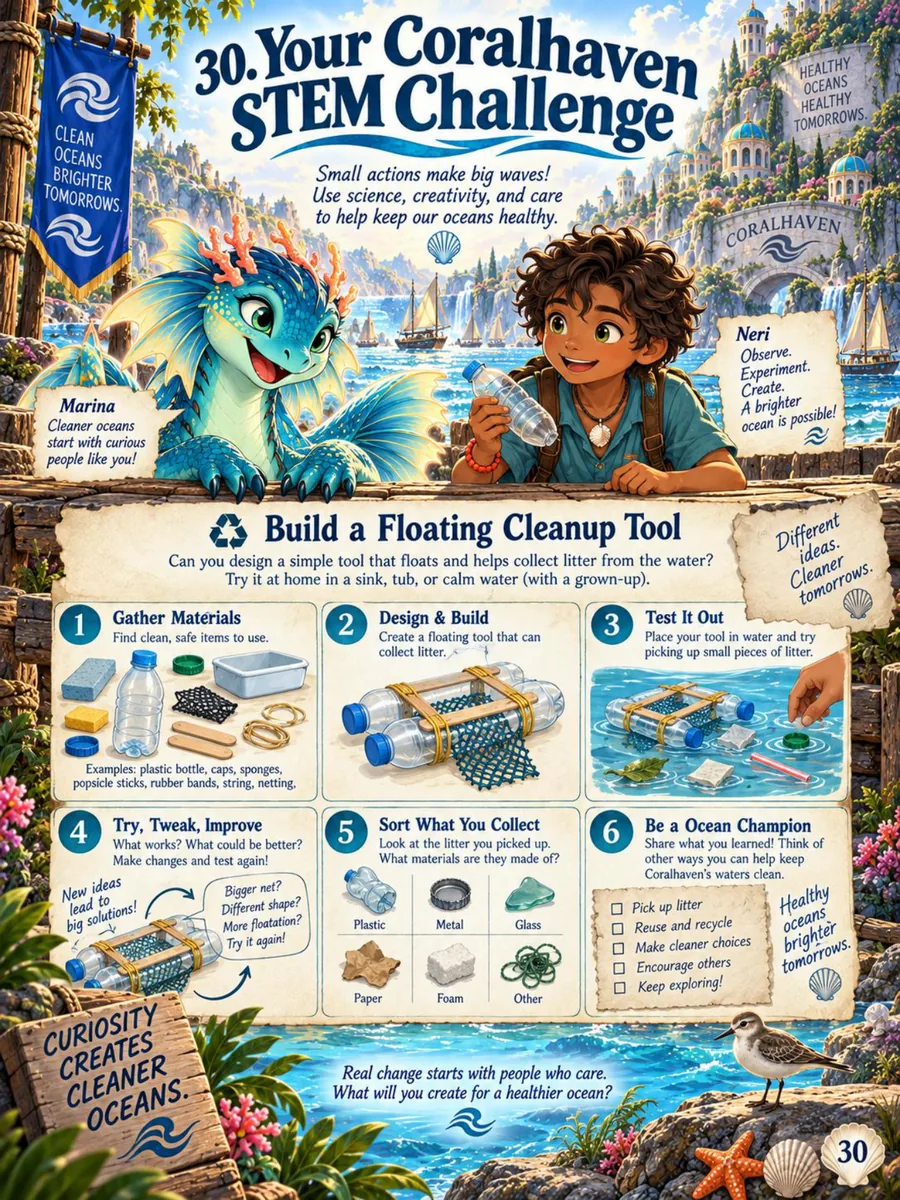
Read the words
Small actions make big waves! Use science, creativity, and care to help keep our oceans healthy.
Marina: "Cleaner oceans start with curious people like you!"
Neri: "Observe. Experiment. Create. A brighter ocean is possible!"
Build a Floating Cleanup Tool: Can you design a simple tool that floats and helps collect litter from the water? Try it at home in a sink, tub, or calm water (with a grown-up).
1 Gather Materials: Find clean, safe items to use. Examples: plastic bottle, caps, sponges, popsicle sticks, rubber bands, string, netting.
2 Design & Build: Create a floating tool that can collect litter.
3 Test It Out: Place your tool in water and try picking up small pieces of litter.
4 Try, Tweak, Improve: What works? What could be better? Make changes and test again!
Bigger net? Different shape? More floatation? Try it again!
New ideas lead to big solutions!
5 Sort What You Collect: Look at the litter you picked up. What materials are they made of? Plastic. Metal. Glass. Paper. Foam. Other.
6 Be a Ocean Champion: Share what you learned! Think of other ways you can help keep Coralhaven's waters clean. Pick up litter. Reuse and recycle. Make cleaner choices. Encourage others. Keep exploring!
Real change starts with people who care. What will you create for a healthier ocean?
- Pick something to design, like a paper boat.
- Write 1 thing it must do: a criterion.
- Write 1 limit you must follow, like using only 1 sheet of paper.
You need: paper, a pencil.
Can you remember? A new backpack must hold books, and cost under 20 dollars. Which one is the limit?
Costing under 20 dollars. That is the constraint.
For grown-ups
Learning goal: I can compare 4 cleanup tools against 3 criteria, find how many more one collected, and build a floating barrier.
Grade 3-5.
| Code | Standard |
|---|---|
| 3-5-ETS1-2 | Generate and compare multiple possible solutions to a problem based on how well each is likely to meet the criteria and constraints of the problem. |
| 3-LS4-4 | Make a claim about the merit of a solution to a problem caused when the environment changes and the types of plants and animals that live there may change. |
| 3.MD.B.3 | Draw a scaled picture graph and a scaled bar graph to represent a data set with several categories. Solve one- and two-step "how many more" and "how many less" problems using information presented in scaled bar graphs. |
| 3-5-ETS1-3 | Plan and carry out fair tests in which variables are controlled and failure points are considered to identify aspects of a model or prototype that can be improved. |
Talk about it:
- When is the 'best' option not simply the one that does the most?
- What criteria would you use to choose a tool for a job at home?
About 8 minutes.
How the game teaches it: evidence first, then the rider's hints (never the answer); no stars, scores or timers.
The full teacher guide is in the book.
Only the pages from this mission are shown here. From the Dragon STEM series by Adisak Sukul.