Dragon STEM · Read it in the book
Play the gameYour game is still open. Switch to its tab.

Float or sink?
Some things float on water. Others sink. Floating litter can ride the currents a long way. It piles up where the water slows down.
Word: Property: something you can observe about a material, like if it floats.
Read the words
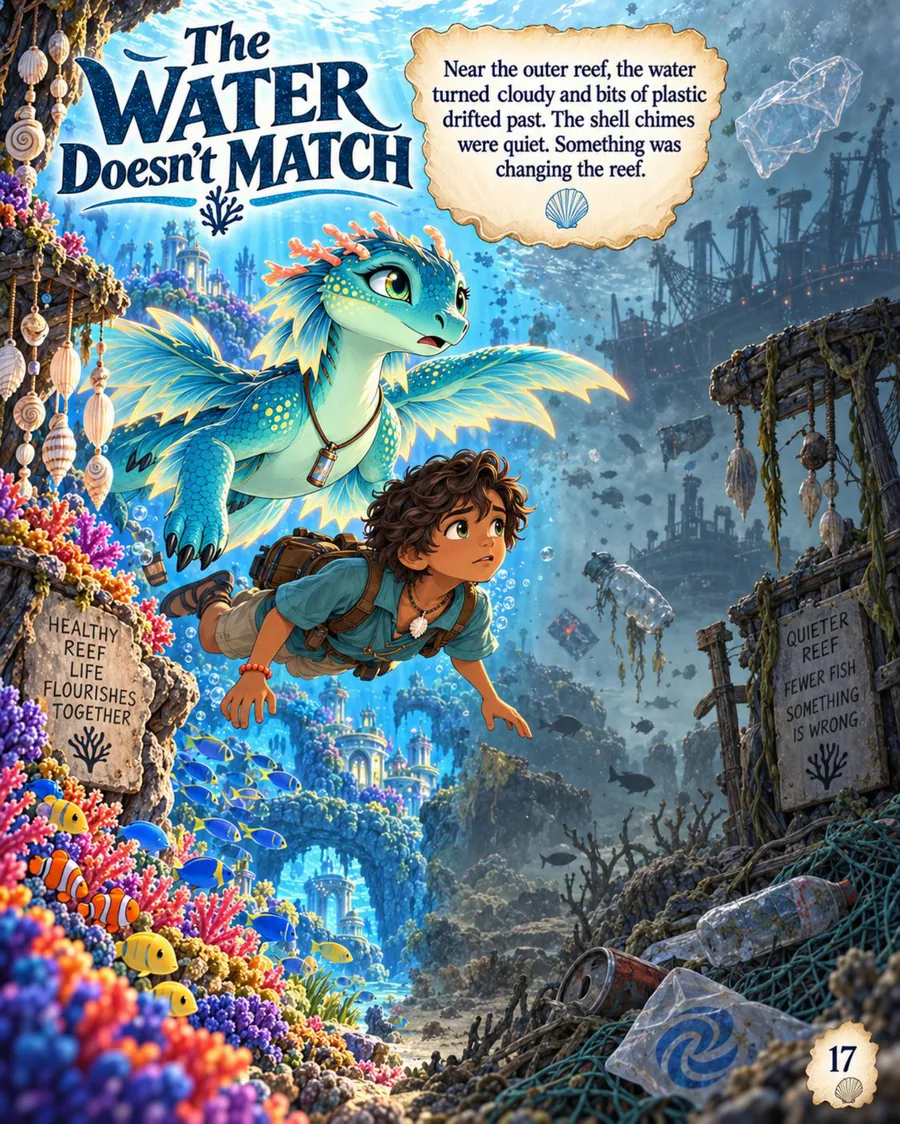
Near the outer reef, the water turned cloudy and bits of plastic drifted past.
The shell chimes were quiet.
Something was changing the reef.
Quieter reef. Fewer fish. Something is wrong.
Read the words
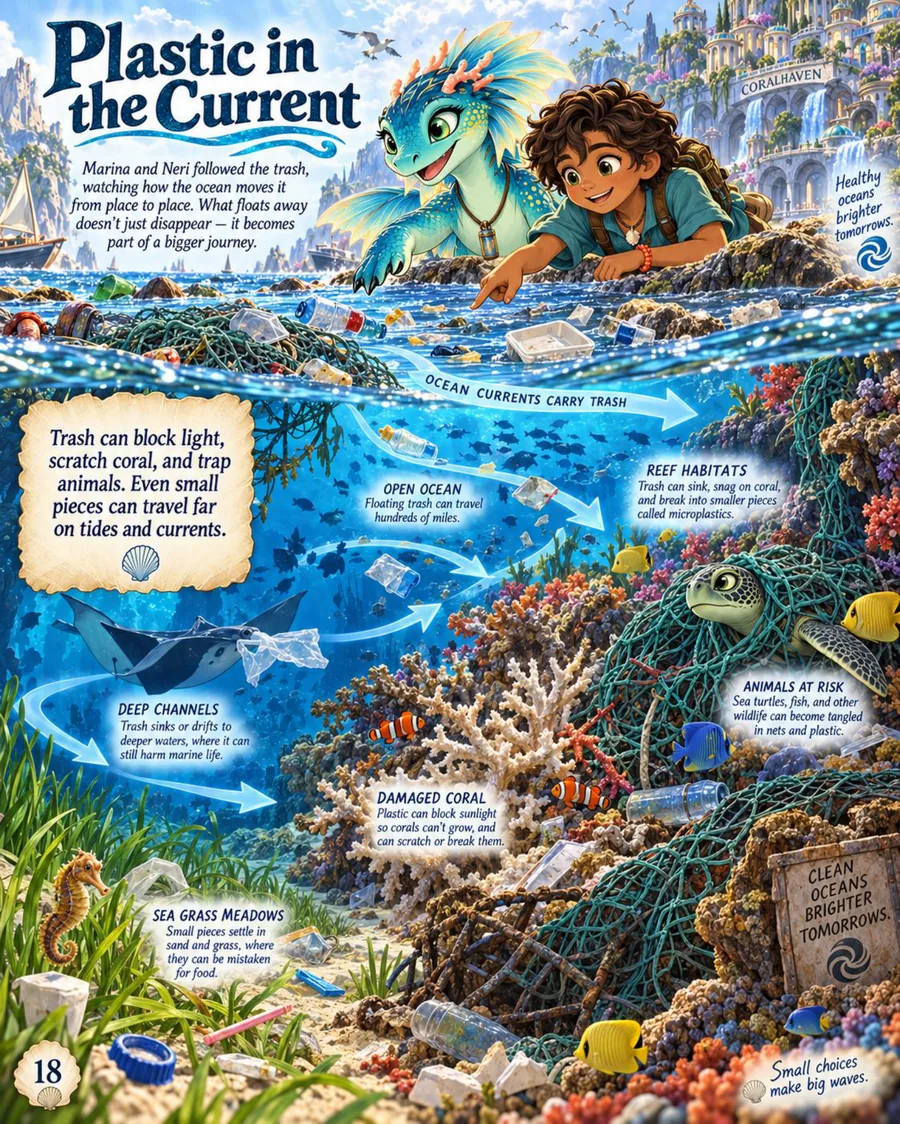
Marina and Neri followed the trash, watching how the ocean moves it from place to place.
What floats away doesn't just disappear — it becomes part of a bigger journey.
Trash can block light, scratch coral, and trap animals. Even small pieces can travel far on tides and currents.
Ocean currents carry trash.
Open Ocean: Floating trash can travel hundreds of miles.
Deep Channels: Trash sinks or drifts to deeper waters, where it can still harm marine life.
Sea Grass Meadows: Small pieces settle in sand and grass, where they can be mistaken for food.
Damaged Coral: Plastic can block sunlight so corals can't grow, and can scratch or break them.
Reef Habitats: Trash can sink, snag on coral, and break into smaller pieces called microplastics.
Animals at Risk: Sea turtles, fish, and other wildlife can become tangled in nets and plastic.
Small choices make big waves.
Read the words
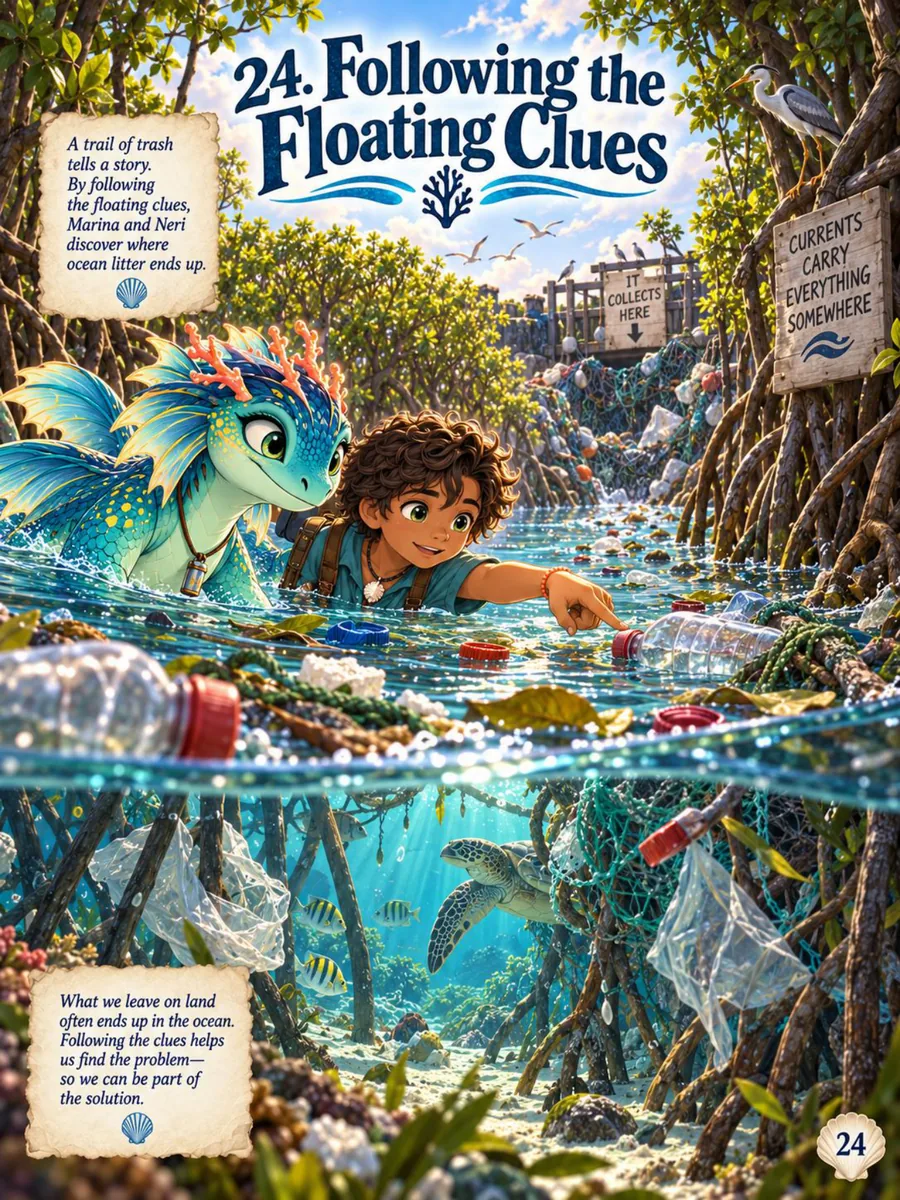
A trail of trash tells a story.
By following the floating clues, Marina and Neri discover where ocean litter ends up.
It collects here.
Currents carry everything somewhere.
What we leave on land often ends up in the ocean.
Following the clues helps us find the problem—so we can be part of the solution.
- Get a coin, a metal spoon, a bottle cap and an apple slice.
- Guess first. Which ones will float?
- Put each one in a bowl of water. Write what happened.
You need: a bowl of water, a coin, a metal spoon, a plastic bottle cap, an apple slice.
Ask a grown-up first. Keep small things away from little kids.
Can you remember? Where does floating litter pile up?
Where the water slows down, like a calm lagoon.
For grown-ups
Learning goal: I can use litter counts and a float test to show where litter collects, and sort litter by what it did in water.
Grade 3-5.
| Code | Standard |
|---|---|
| 5-PS1-3 | Make observations and measurements to identify materials based on their properties. |
| 3.MD.B.3 | Draw a scaled picture graph and a scaled bar graph to represent a data set with several categories. Solve one- and two-step "how many more" and "how many less" problems using information presented in scaled bar graphs. |
| 5-ESS3-1 | Obtain and combine information about ways individual communities use science ideas to protect the Earth's resources and environment. |
Talk about it:
- Where does your household's trash and recycling end up after pickup?
- Why might something float in fresh water but sink in salt water?
About 7 minutes.
How the game teaches it: evidence first, then the rider's hints (never the answer); no stars, scores or timers.
The full teacher guide is in the book.
Only the pages from this mission are shown here. From the Dragon STEM series by Adisak Sukul.