Dragon STEM · Read it in the book
Play the gameYour game is still open. Switch to its tab.

Goals and limits
Criteria are what a design must do. Constraints are the limits we must follow. A filter's criterion is to catch ash. A constraint is using only what we have.
Word: Criteria: what a design must do to succeed.
Read the words
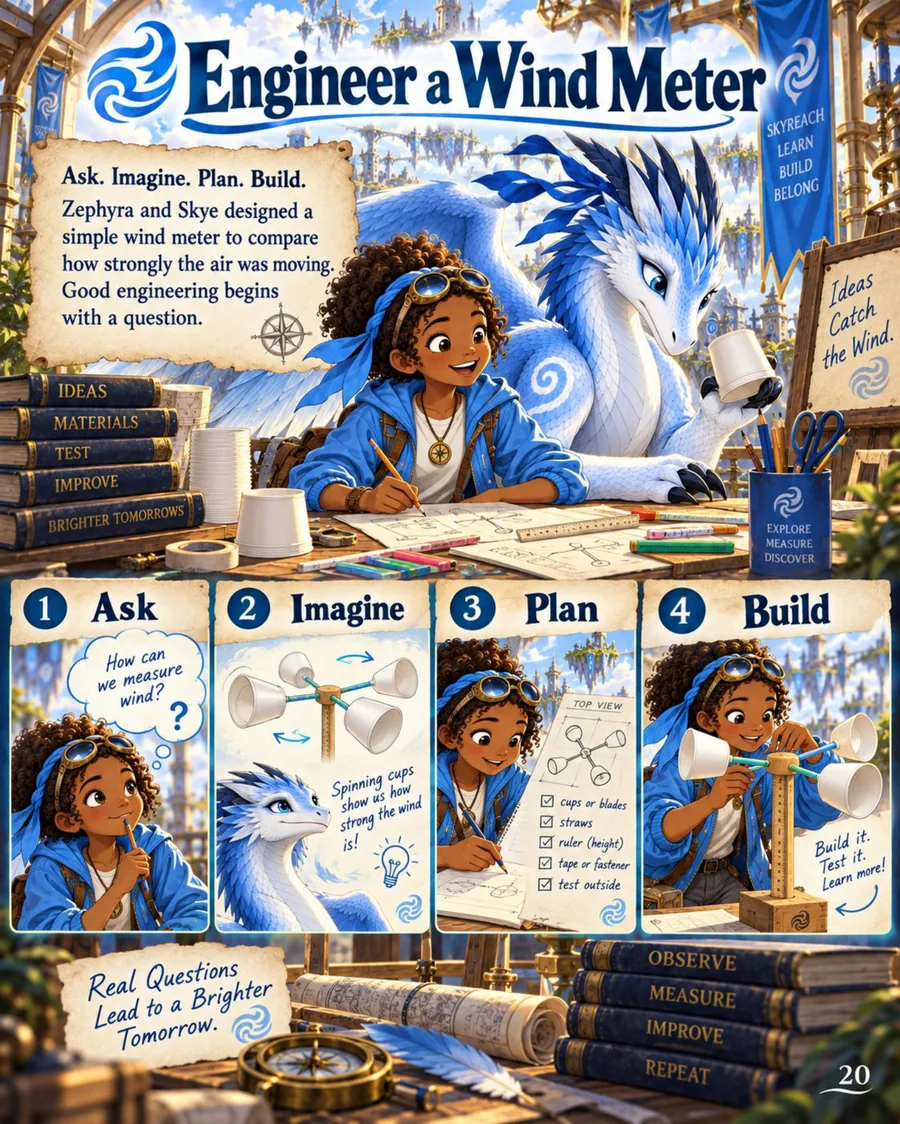
Ask. Imagine. Plan. Build.
Zephyra and Skye designed a simple wind meter to compare how strongly the air was moving.
Good engineering begins with a question.
1 Ask: "How can we measure wind?"
2 Imagine: Spinning cups show us how strong the wind is!
3 Plan: cups or blades, straws, ruler (height), tape or fastener, test outside.
4 Build: Build it. Test it. Learn more!
Read the words
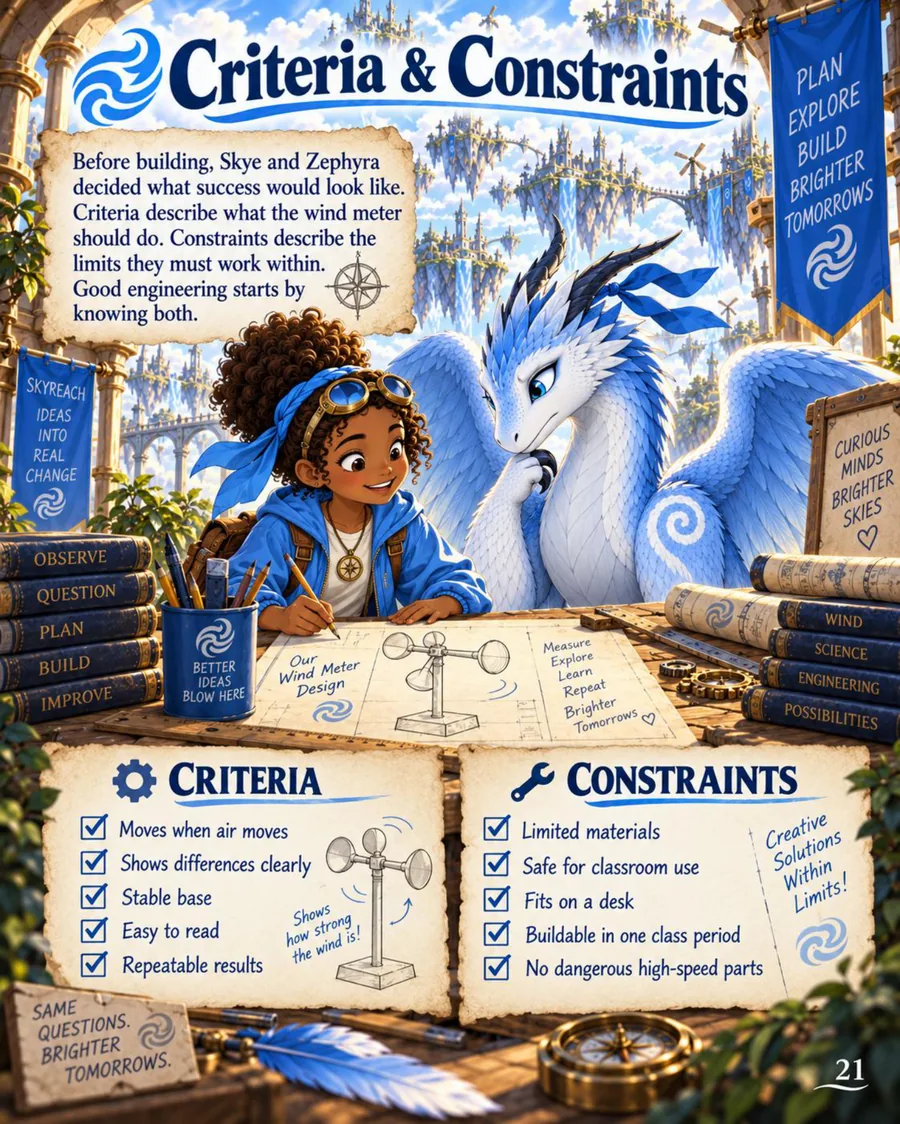
Before building, Skye and Zephyra decided what success would look like.
Criteria describe what the wind meter should do.
Constraints describe the limits they must work within.
Good engineering starts by knowing both.
Criteria: Moves when air moves. Shows differences clearly. Stable base. Easy to read. Repeatable results.
Constraints: Limited materials. Safe for classroom use. Fits on a desk. Buildable in one class period. No dangerous high-speed parts.
Read the words
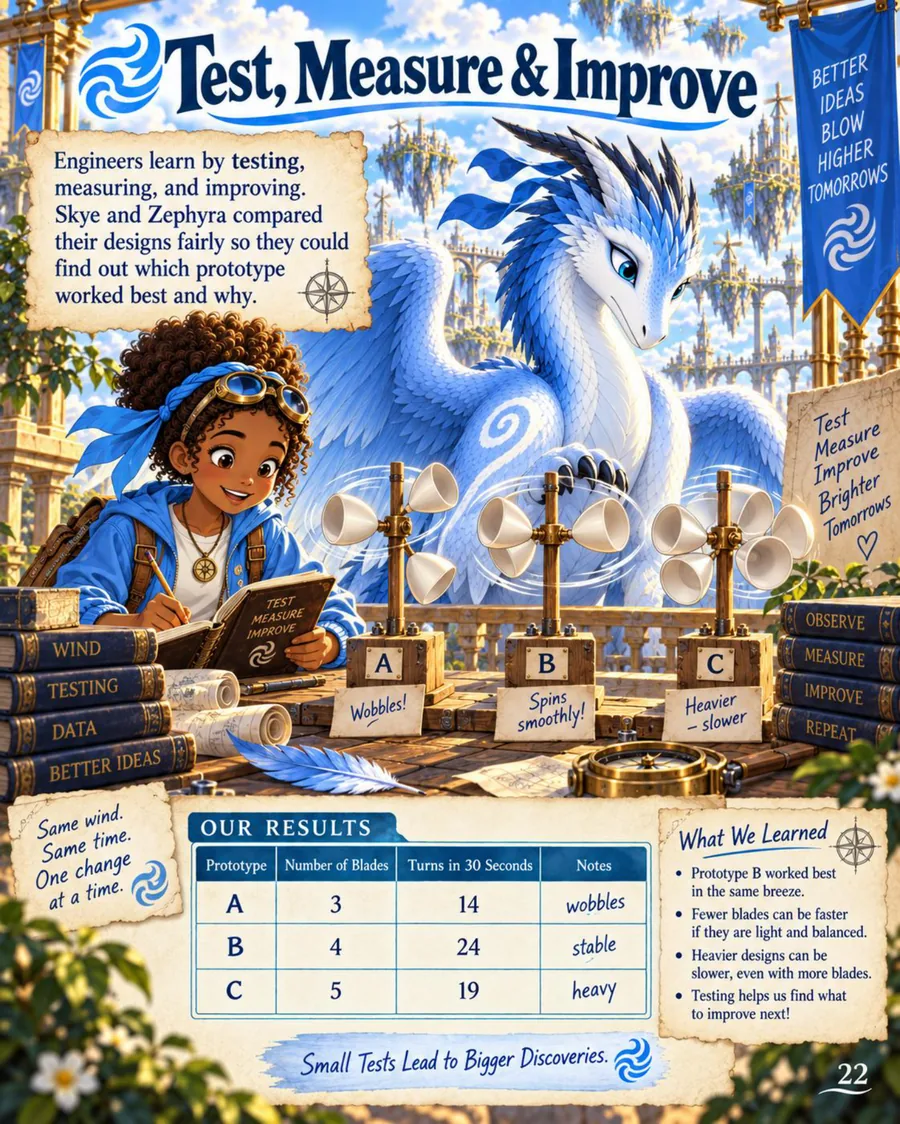
Engineers learn by testing, measuring, and improving.
Skye and Zephyra compared their designs fairly so they could find out which prototype worked best and why.
Same wind. Same time. One change at a time.
Our Results — Prototype A: 3 blades, 14 turns in 30 seconds, wobbles. Prototype B: 4 blades, 24 turns in 30 seconds, stable. Prototype C: 5 blades, 19 turns in 30 seconds, heavy.
What We Learned: Prototype B worked best in the same breeze. Fewer blades can be faster if they are light and balanced. Heavier designs can be slower, even with more blades. Testing helps us find what to improve next!
Small Tests Lead to Bigger Discoveries.
- Pick something to design, like a paper boat.
- Write 1 thing it must do: a criterion.
- Write 1 limit you must follow, like using only 1 sheet of paper.
You need: paper, a pencil.
Can you remember? A new backpack must hold books, and cost under 20 dollars. Which one is the limit?
Costing under 20 dollars. That is the constraint.
For grown-ups
Learning goal: I can plan a fair test, compare 3 designs against several goals, and explain why the best design meets every goal.
Grade 3-5.
| Code | Standard |
|---|---|
| 3-5-ETS1-3 | Plan and carry out fair tests in which variables are controlled and failure points are considered to identify aspects of a model or prototype that can be improved. |
| 3-5-ETS1-2 | Generate and compare multiple possible solutions to a problem based on how well each is likely to meet the criteria and constraints of the problem. |
| 3-5-ETS1-1 | Define a simple design problem reflecting a need or a want that includes specified criteria for success and constraints on materials, time, or cost. |
Talk about it:
- What everyday object at home could be redesigned and fairly tested, changing only one thing at a time?
- Why might the 'best' choice not be the one with the single highest number?
About 8 minutes.
How the game teaches it: evidence first, then the rider's hints (never the answer); no stars, scores or timers.
The full teacher guide is in the book.
Only the pages from this mission are shown here. From the Dragon STEM series by Adisak Sukul.