Dragon STEM · Read it in the book
Play the gameYour game is still open. Switch to its tab.

Equal groups
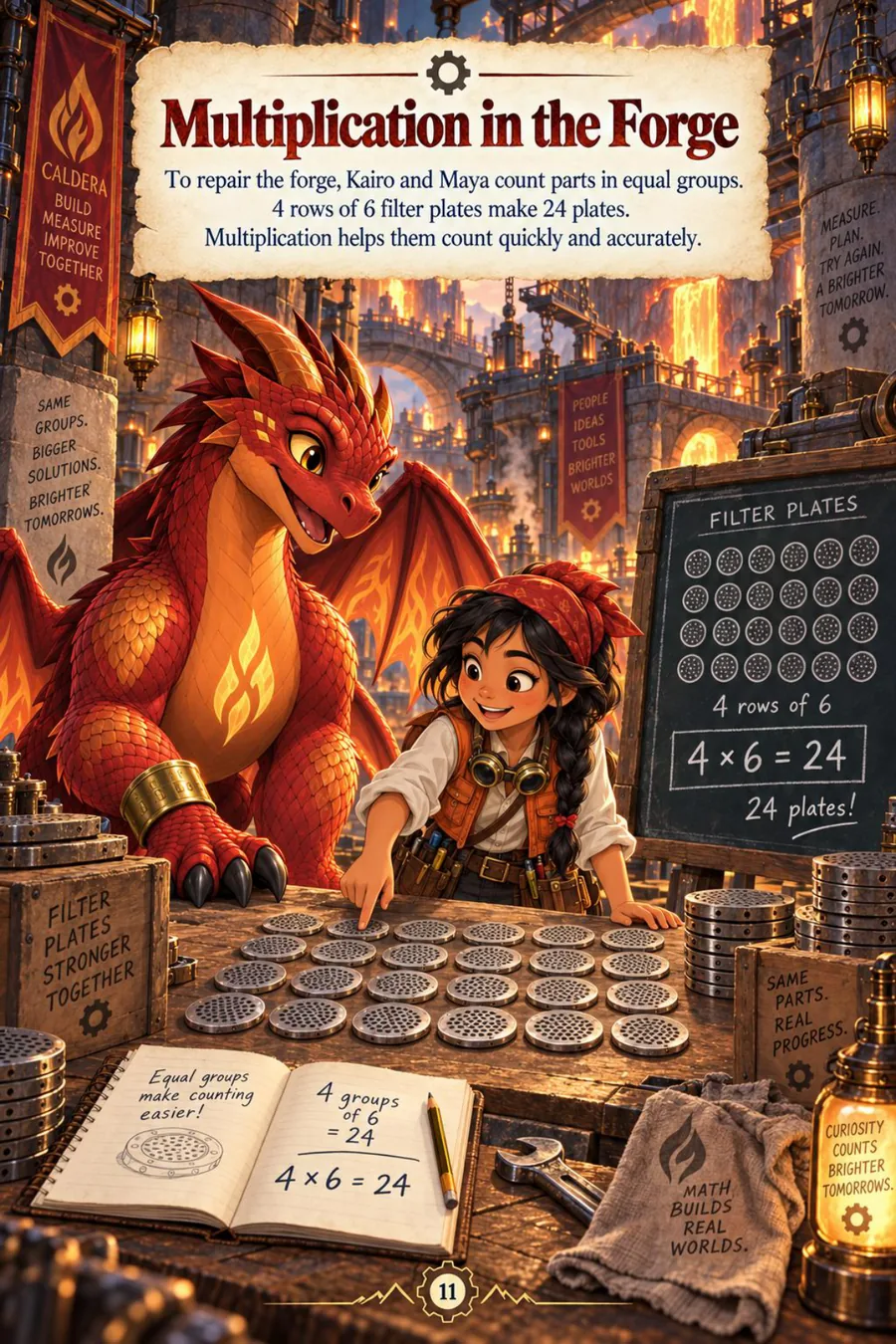
Equal groups all have the same number in them. They make counting easy. 4 rows of 6 plates make 4 × 6 = 24 plates.
Word: Equal groups: groups that all have the same number in them.
Read the words
To repair the forge, Kairo and Maya count parts in equal groups.
4 rows of 6 filter plates make 24 plates.
Multiplication helps them count quickly and accurately.
Filter Plates: 4 rows of 6. 4 × 6 = 24. 24 plates!
Equal groups make counting easier! 4 groups of 6 = 24. 4 × 6 = 24.
Read the words
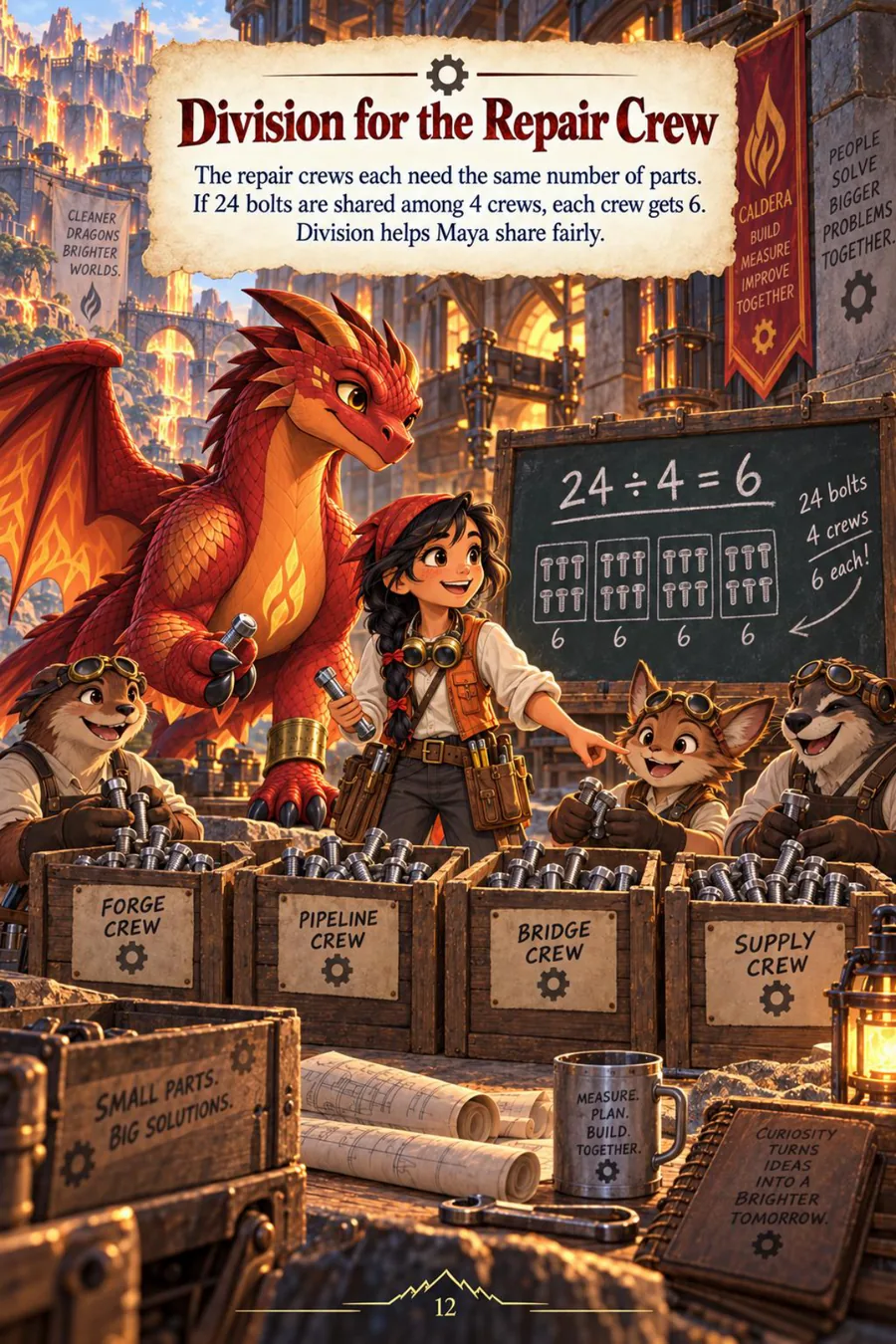
The repair crews each need the same number of parts.
If 24 bolts are shared among 4 crews, each crew gets 6.
Division helps Maya share fairly.
24 ÷ 4 = 6. 24 bolts, 4 crews, 6 each!
Crews: Forge Crew, Pipeline Crew, Bridge Crew, Supply Crew — 6 bolts each.
- Find 3 equal groups of toys or blocks at home.
- Count how many are in 1 group.
- Multiply to find the total. Count every one to check.
You need: toys or blocks.
Can you remember? 4 baskets each hold 7 apples. How many apples are there in all?
28 apples. 4 × 7 = 28.
For grown-ups
Learning goal: I can multiply to count equal groups and divide to share things fairly.
Grade 3.
| Code | Standard |
|---|---|
| 3.OA.A.1 | Interpret products of whole numbers, e.g., interpret 5 × 7 as the total number of objects in 5 groups of 7 objects each. For example, describe a context in which a total number of objects can be expressed as 5 × 7. |
| 3.OA.A.2 | Interpret whole-number quotients of whole numbers, e.g., interpret 56 ÷ 8 as the number of objects in each share when 56 objects are partitioned equally into 8 shares, or as a number of shares when 56 objects are partitioned into equal shares of 8 objects each. For example, describe a context in which a number of shares or a number of groups can be expressed as 56 ÷ 8. |
| 3.OA.C.7 | Fluently multiply and divide within 100, using strategies such as the relationship between multiplication and division (e.g., knowing that 8 × 5 = 40, one knows 40 ÷ 5 = 8) or properties of operations. By the end of Grade 3, know from memory all products of two one-digit numbers. |
Talk about it:
- How does multiplying by equal groups save counting time compared to counting one by one?
- When has your family divided something so that each person got an equal share?
About 8 minutes.
How the game teaches it: evidence first, then the rider's hints (never the answer); no stars, scores or timers.
The full teacher guide is in the book.
Only the pages from this mission are shown here. From the Dragon STEM series by Adisak Sukul.