Dragon STEM · Read it in the book
Play the gameYour game is still open. Switch to its tab.

Measure first
A guess is an idea. A measurement is evidence. Kairo and Maya read the gauges before they acted. Then they compared today with yesterday.
Word: Data: facts and numbers we collect to answer a question.
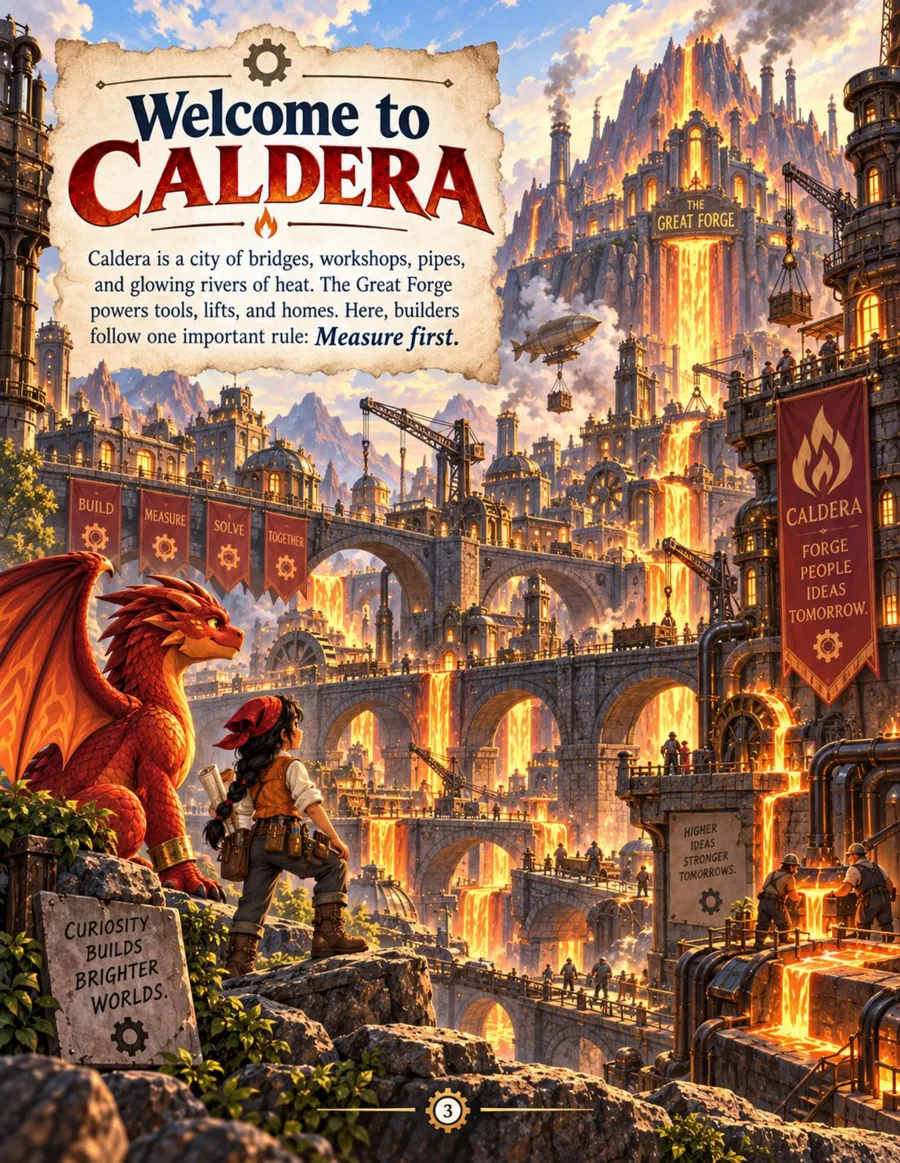
Read the words
Caldera is a city of bridges, workshops, pipes, and glowing rivers of heat.
The Great Forge powers tools, lifts, and homes.
Here, builders follow one important rule: Measure first.
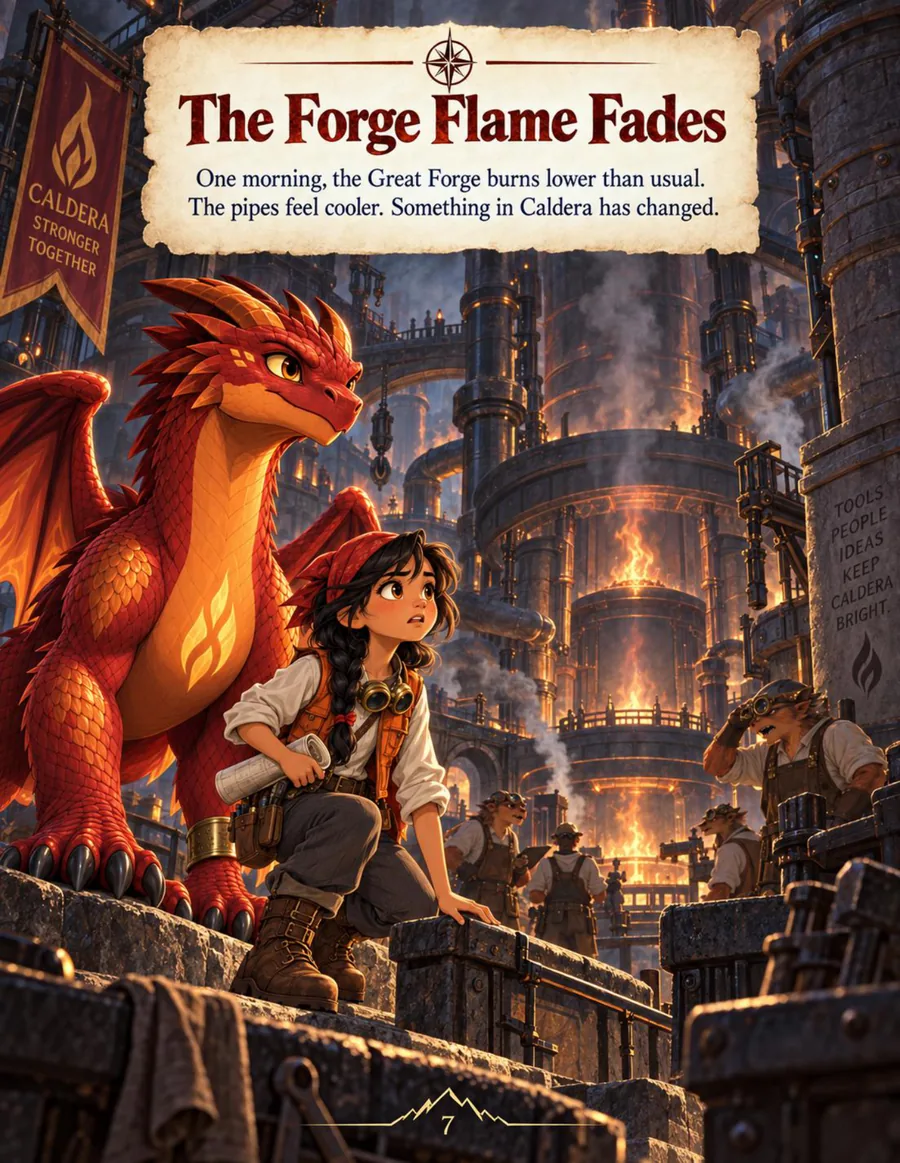
Read the words
One morning, the Great Forge burns lower than usual.
The pipes feel cooler.
Something in Caldera has changed.
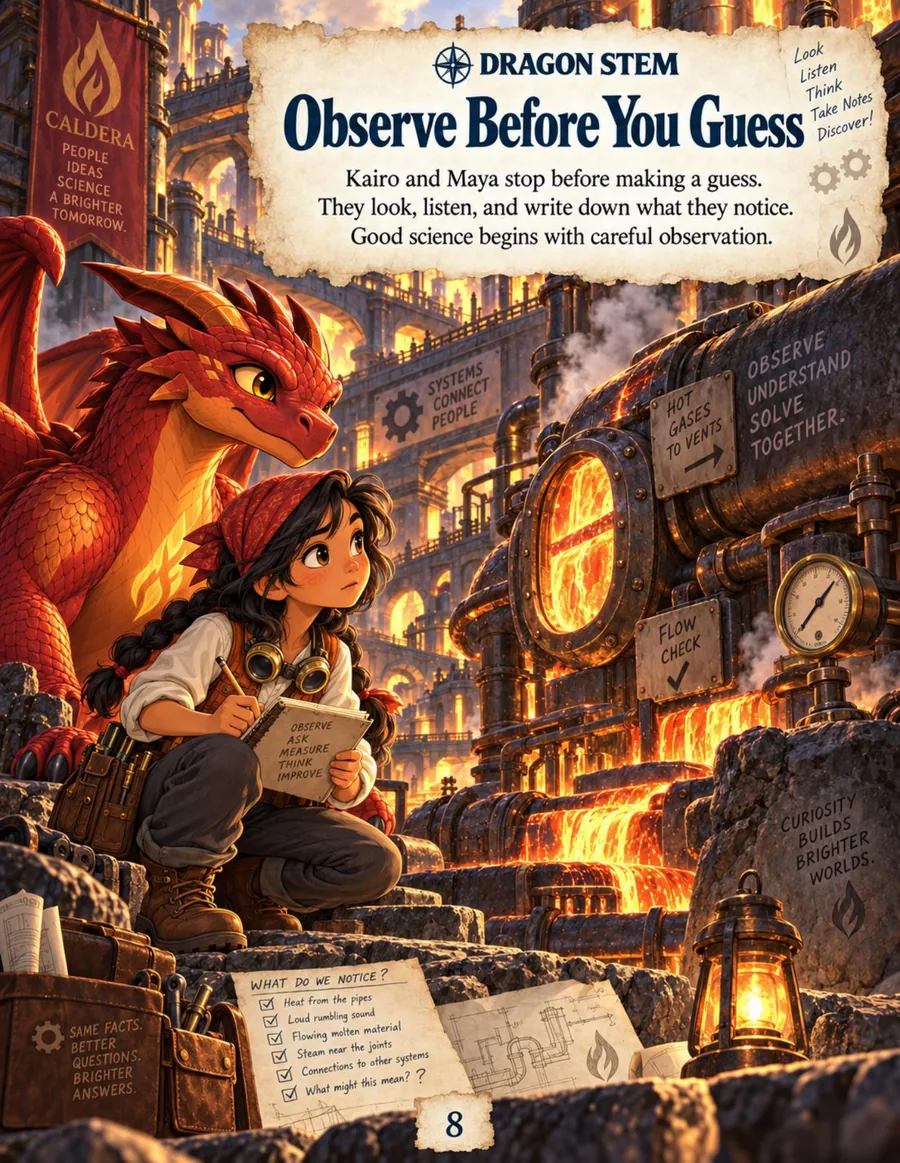
Read the words
Kairo and Maya stop before making a guess.
They look, listen, and write down what they notice.
Good science begins with careful observation.
Look. Listen. Think. Take notes. Discover!
Notebook: Observe. Ask. Measure. Think. Improve.
What do we notice? Heat from the pipes. Loud rumbling sound. Flowing molten material. Steam near the joints. Connections to other systems. What might this mean?
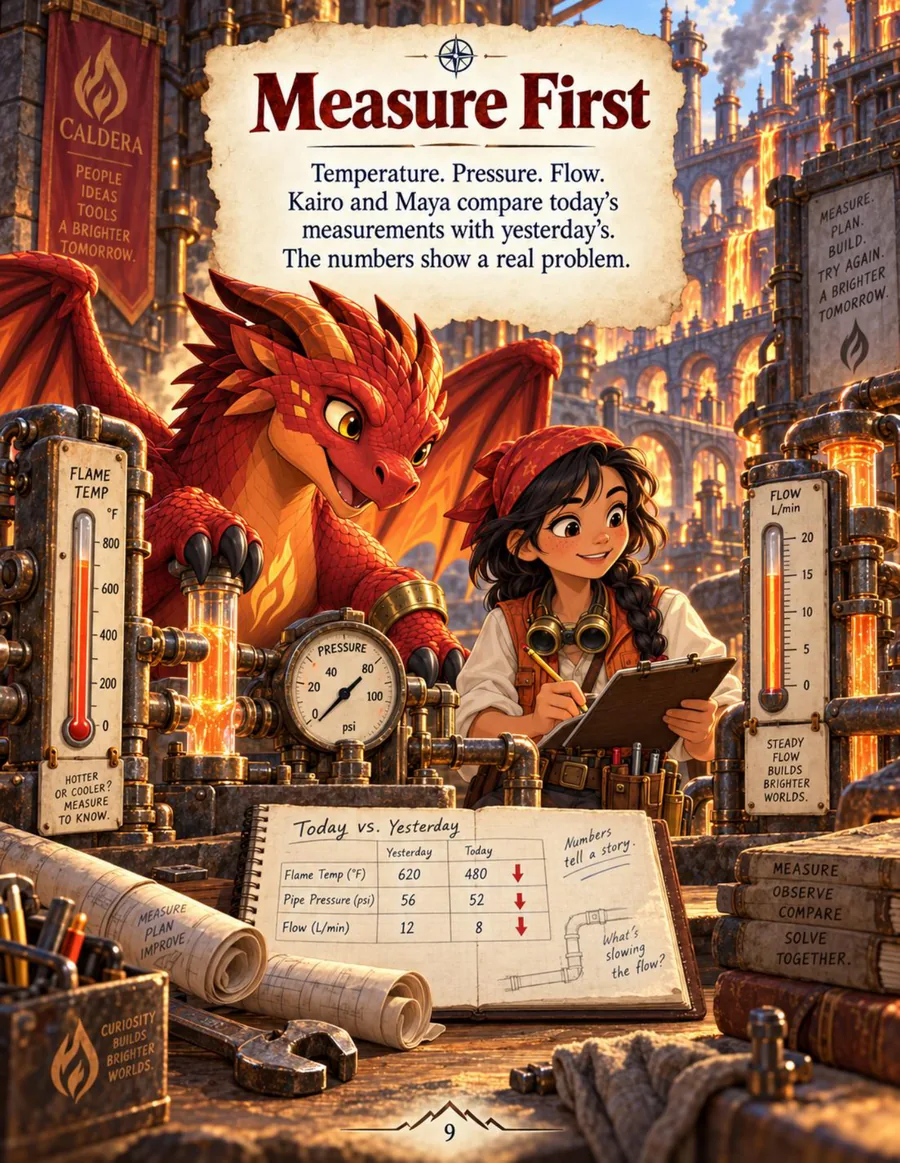
Read the words
Temperature. Pressure. Flow.
Kairo and Maya compare today's measurements with yesterday's.
The numbers show a real problem.
Flame Temp (°F): Yesterday 620, Today 480.
Pipe Pressure (psi): Yesterday 56, Today 52.
Flow (L/min): Yesterday 12, Today 8.
Numbers tell a story. What's slowing the flow?
Real-world note. The game says degrees Celsius (°C). This page says °F. Both are story numbers.
For grown-ups
The flame, pressure and flow numbers on this page are story numbers. The game shows the flame in degrees Celsius (°C), the unit used in science class; this page labels it °F. The game also adds a pipe thermometer (208 then 142) and reads the flow as supply-wheel turns a minute; this page shows only flame temperature, pressure and flow (L/min).
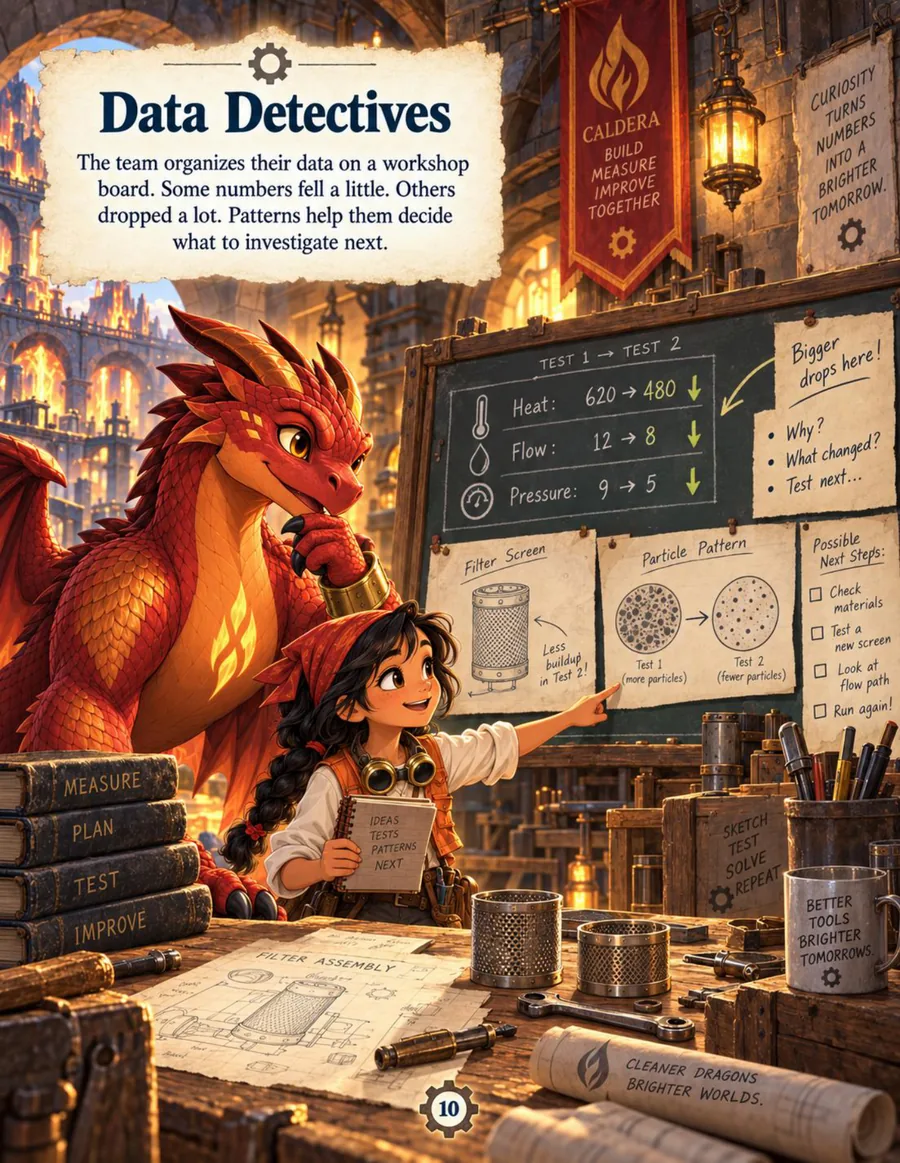
Read the words
The team organizes their data on a workshop board.
Some numbers fell a little. Others dropped a lot.
Patterns help them decide what to investigate next.
Test 1 to Test 2: Heat 620 to 480. Flow 12 to 8. Pressure 9 to 5.
Bigger drops here! Why? What changed? Test next…
Filter Screen: less buildup in Test 2.
Particle Pattern: Test 1 has more particles, Test 2 has fewer particles.
Possible next steps: Check materials. Test a new screen. Look at flow path. Run again!
Real-world note. The game uses the pressure numbers from page 9 (56, then 52).
For grown-ups
This page shows pressure falling from 9 to 5, but page 9 shows 56 to 52. The two pages disagree. The game uses page 9's readings, where pressure changed only a little while heat and flow changed much more.
- Measure 3 shoes in your home with a ruler.
- Write each length down.
- Which 2 shoes are the most different? Subtract to check.
You need: a ruler, 3 shoes, paper, a pencil.
Can you remember? An oven was 350 °C. Now it is 290 °C. How much cooler is it?
60 °C cooler. 350 − 290 = 60.
For grown-ups
Learning goal: I can read four gauges, find how much a reading changed, and use the changes to decide what to check next.
Grade 3.
| Code | Standard |
|---|---|
| 3.NBT.A.2 | Fluently add and subtract within 1000 using strategies and algorithms based on place value, properties of operations, and/or the relationship between addition and subtraction. |
| 3.OA.A.3 | Use multiplication and division within 100 to solve word problems in situations involving equal groups, arrays, and measurement quantities. |
| 3-5-ETS1-1 | Define a simple design problem reflecting a need or a want that includes specified criteria for success and constraints on materials, time, or cost. |
| MP6 | Attend to precision. |
Talk about it:
- Why is comparing today's reading with yesterday's more convincing than a single guess?
- Where at home could you compare two measurements instead of guessing what changed?
About 7 minutes.
How the game teaches it: evidence first, then the rider's hints (never the answer); no stars, scores or timers.
The full teacher guide is in the book.
Only the pages from this mission are shown here. From the Dragon STEM series by Adisak Sukul.